EPR · Pay-on-Behalf Compliance Mechanism (France EPR)
How does the marketplace pay-on-behalf mechanism work for France EPR?
The rules that force online marketplaces to collect and remit eco-contributions for unregistered sellers in France.
The pay-on-behalf mechanism is a French Extended Producer Responsibility (EPR) rule that legally requires online marketplaces to manage, report, and pay eco-contributions for any third-party seller on their platform who cannot provide a valid Unique Identification Number (IDU). Failing to display a valid IDU carries an administrative fine of up to 30,000 EUR.
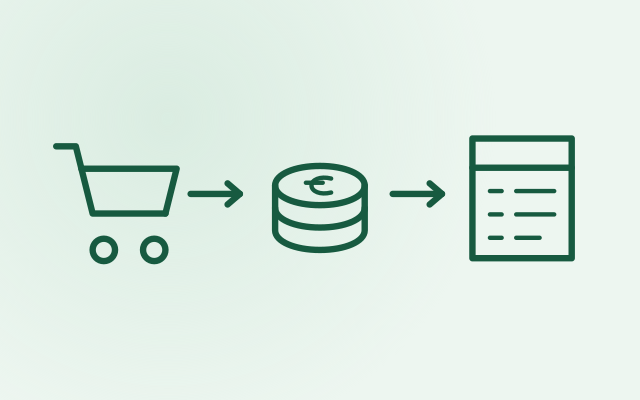
When selling packaged goods into France through an online platform, merchants often assume that the marketplace handles all local tax and environmental duties automatically. Under the French framework, this is only partially true. The French government shifted the enforcement burden onto the platforms themselves, making them the ultimate guarantor of environmental compliance for the goods sold through their infrastructure. If a seller fails to register with an approved eco-organisation, the platform steps in to cover the gap.
The pay-on-behalf mechanism stops unregistered sellers from ignoring their producer responsibilities while selling to French consumers. Instead of chasing thousands of small overseas merchants, the French authorities hold the marketplace accountable. For the seller, this means the platform will deduct the estimated recycling costs directly from their sales payouts, often adding administrative fees. Understanding this mechanism is the only way a seller can take back control of their margins and compliance status in France.
What the pay-on-behalf mechanism actually means
At its core, the pay-on-behalf mechanism acts as a safety net for the French Extended Producer Responsibility system. It dictates that a marketplace - defined as any electronic interface, platform, or portal that facilitates distance sales or the delivery of EPR-applicable products for a third-party seller - is considered the producer if the actual seller is not registered.
If an online seller does not possess a valid Unique Identification Number (IDU), the marketplace is legally obligated to declare the packaging and pay the corresponding environmental contribution on the seller's behalf.
In practice, platforms must track the compliance status of every merchant using their services. They are required to maintain an up-to-date register of their third-party sellers, which must include the seller's identity, their IDU for each relevant EPR category, and the number of packaged products sold annually through the marketplace. If a seller provides a valid IDU, the marketplace simply records it and the seller continues to report their own packaging. If no IDU is provided, the marketplace must step in, report the packaging, and remit the fees to the eco-organisation.
Does this apply to me?
The pay-on-behalf rule applies to any merchant selling physical goods to French consumers via an online marketplace or delivery platform, as well as to the platforms themselves. Since 1 January 2022, the requirement has been actively enforced across all EPR categories in France, including household packaging, printed paper, and textiles.
There is no minimum sales threshold for the seller. From the very first packaged product sold to a French household, the EPR obligation exists. If you sell via a platform and do not have an IDU, the platform will apply the pay-on-behalf rules to your account. To comply and avoid these automatic platform deductions, sellers must register directly with a French eco-organisation (such as Citeo for packaging), obtain their 15-character IDU from the ADEME (the French agency for ecological transition), and provide this number to the marketplace.
What deductions and fines does the pay-on-behalf mechanism apply to a seller's account?
When a marketplace pays on a seller's behalf, it uses specific reporting structures and applies deductions to the seller's account based on the data it holds.
| Metric | Value | Detail |
|---|---|---|
| Enforcement date | 1 January 2022 | The date from which marketplaces became legally responsible for declaring the packaging of their unregistered sellers. |
| IDU length | 15 characters | The exact format of the Unique Identification Number required to stop pay-on-behalf deductions. |
| Platform reporting limit | 500,000 products | The maximum number of packaged products a marketplace can report per seller using the simplified marketplace declaration designed by Citeo. |
| Product families | 64 | The number of distinct product families available under the simplified marketplace declaration, which integrates the product packaging and the shipping box. |
| Missing IDU penalty | Up to 30,000 EUR | The administrative fine a company faces for not having a valid IDU listed in their terms and conditions or on their website. |
| Non-compliance fine | Up to 7,500 EUR | The penalty applied per tonne or per unit of product for failing to respect EPR obligations. |
Common misconceptions about the pay-on-behalf mechanism
“The marketplace covers the cost for free”
Marketplaces do not absorb these environmental fees out of goodwill. They will calculate the cost of the eco-contributions and deduct them directly from your seller disbursements. In many cases, they will also apply their own administrative surcharge for managing the reporting on your behalf.
“It only applies to large e-commerce businesses”
The rule applies from the very first sale. Whether you sell a handful of items or thousands of units into France, the platform is legally required to check your registration status. If you do not have an IDU, they must withhold the fees.
“Using pay-on-behalf keeps me fully compliant”
While the marketplace remits the financial contribution for the packaging sold on their specific platform, this does not cover your sales through your own website or other channels. Furthermore, French law still requires the merchant to display their IDU in their own terms and conditions to be fully compliant.
“I can switch back and forth whenever I want”
Marketplaces report on strict annual or quarterly cycles. If you delay getting your own IDU, the platform will report for you, and transitioning mid-cycle can lead to double-paying fees or complicated reconciliation processes with the platform to stop their deductions.
5 examples of how the mechanism is applied
The unregistered clothing brand
A British merchant sells t-shirts on a major French platform without an IDU. The platform detects the missing registration, reports the plastic mailers and cardboard tags to Citeo under the simplified marketplace declaration, and deducts the fee from the merchant's payout.
The independent website seller
A merchant sells entirely through their own independent web store, rather than an electronic interface that facilitates distance sales for third parties. The pay-on-behalf mechanism does not apply here. The merchant is solely responsible for registering and paying the eco-organisation directly.
The multi-platform retailer
A seller uses three different online marketplaces to reach French consumers. They obtain a single IDU from the ADEME and upload it to all three portals. All three platforms verify the number and cease their automatic pay-on-behalf deductions.
The food delivery restaurant
A local restaurant uses a delivery app to send meals in single-use plastic bowls. Because the restaurant has no IDU, the delivery platform is forced to declare the packaging and applies a specific fee per order to cover the contribution.
The second-hand importer
An overseas business sells vintage electronics in their original packaging to French households via a marketplace. Because they are the first importer, the EPR rules apply, and without an IDU, the platform acts as the producer and withholds the fees.
Terms related to the pay-on-behalf mechanism
| Term | What it means |
|---|---|
| AGEC Law (France) | The French anti-waste law that introduced the marketplace liability rules and the mandatory Unique Identification Number. |
| IDU (Identifiant Unique) | The 15-character registration code that proves a seller is compliant and stops marketplace deductions. |
| SYDEREP Portal (France) | The central French registry managed by the ADEME where all producer and marketplace compliance data is ultimately recorded. |
| EPR Registration Number (ERN) | The general concept of a producer registration number, which in France specifically takes the form of the IDU. |
Frequently asked questions
Do I have to use the pay-on-behalf service?
No, it is generally considered a default fallback rather than a mandatory service. Sellers are highly encouraged to obtain their own IDU and manage their own compliance. Once you provide a valid IDU to the platform, they will stop declaring and paying on your behalf.
How does a marketplace know if I am compliant?
Marketplaces use a specific search engine and database provided by the ADEME to verify the validity of the IDUs submitted by their sellers. They can check exactly which company or entity the identifier belongs to, ensuring the seller is actively registered for the correct product category.
What happens if I sell on a marketplace and my own website?
The pay-on-behalf mechanism only covers the sales processed through that specific marketplace interface. Any sales made directly to French consumers via your own website are entirely your responsibility. You must register, obtain an IDU, and report those direct sales yourself to the relevant eco-organisation.
Will the marketplace backdate my fees?
If you have been selling into France without an IDU since the rules came into effect on 1 January 2022, the marketplace is liable for those historical sales. They will likely calculate the owed contributions for past periods and deduct a lump sum from your account to cover their compliance costs.
Does this only apply to packaging?
No. The French marketplace liability rules apply across all Extended Producer Responsibility categories. If you sell electronic goods, batteries, furniture, or textiles via a platform, the marketplace must verify your IDU for each respective category or pay the fees on your behalf.
Sources:
Written by Daniel Vaknine, Co-founder – Compliance & Operations · Last reviewed 27 Jul 2026