Is polystyrene recyclable, and what does it mean for your packaging fees?
A practical guide to PS recycling, recyclability assessment and packaging EPR costs in Europe.
Yes, polystyrene is recyclable in some packaging formats, but recyclability depends on whether that exact design can enter an established collection, sorting and recycling stream. RecyClass currently recognises PS containers and selected EPS packaging streams, while France reports that less than 20% of EPS protective packaging is presently sorted into its developing route.
Is polystyrene recyclable in Europe?
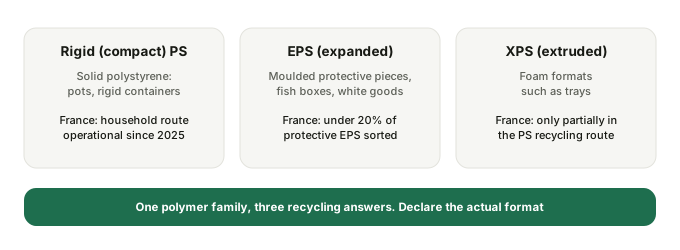
Yes, but “polystyrene” is too broad to produce one recycling answer. Rigid PS containers, EPS protective packaging and XPS trays have different physical properties and can follow different recycling routes, so a recyclability claim should be tied to the specific packaging format and target market.
RecyClass's current European packaging guidance lists recycling assessment routes for natural, white and coloured PS containers and for two specific EPS applications: fish boxes and white-goods packaging. Its online tool separately warns that packaging formats without an available European recycling stream cannot be assessed as recyclable under the RecyClass methodology.
France also shows why blanket statements quickly become outdated. Citeo said in September 2025 that the national recycling route for compact household PS had become operational, with two selected recyclers treating that stream. At the same time, Citeo described EPS and XPS recycling as more limited.
What is the difference between PS, EPS and XPS packaging?
Rigid or compact PS is the solid polystyrene used in formats such as pots and some rigid containers. EPS is expanded polystyrene, the lightweight cellular material commonly moulded into protective pieces around products. XPS is extruded polystyrene foam and can be used in formats such as trays.
Citeo's French household-packaging figures illustrate the different applications. It reported around 85,000 tonnes of PS-family household packaging placed on the French market annually, comprising about 60,000 tonnes of compact PS, 15,000 tonnes of EPS and 10,000 tonnes of XPS in the categories it described in 2025. Those are French Citeo figures, not EU totals.
The distinction matters for EPR declarations too. A business should declare the actual packaging material and category required by the national scheme rather than treating every foam or rigid plastic component as interchangeable.
Why can EPS be harder to recycle than rigid PS?
EPS can be recyclable where the right collection and processing route exists, but its low-density protective format creates practical collection and sorting challenges. Citeo reports that EPS cushioning can break easily and that the sorting rate for EPS protective elements in France is currently below 20%, while additional collection routes are being explored.
RecyClass nevertheless has a dedicated EPS recyclability evaluation protocol for white-goods packaging and fish boxes. The protocol evaluates whether innovations such as barriers, additives, labels, adhesives and non-PS components remain compatible with the established EPS recycling process.
A material name is not a recyclability verdict. The packaging format, components, sorting behaviour and available recycling stream all matter.
Is XPS recyclable?
XPS should not be assumed to have the same route as compact PS. In France, Citeo said in 2025 that XPS trays remained only partially integrated into the PS recycling route and that work was continuing to identify which XPS packaging could be accepted.
The three-way split is a useful compliance lesson beyond France. “PS”, “EPS” and “XPS” appear as distinct categories within the PPWR's indicative list of plastic packaging categories, so the future EU recyclability assessment is designed to distinguish packaging types rather than assign one universal result to the entire polymer family.
What PPWR recyclability grade does polystyrene get?
There is no defensible single answer such as “PS is grade C”. PPWR Article 6 and Annex II establish grades A, B and C from 2030, with A representing at least 95% recyclability by weight, B at least 80% and C at least 70% under the Regulation's assessment framework.
The legal grade will be determined for the packaging unit using EU design-for-recycling criteria. The Commission must establish those detailed criteria through delegated acts, and the Regulation lists PS, XPS and EPS within the relevant plastic packaging categories. From 2035, the assessment also incorporates recycling-at-scale criteria.
The methodology-versus-law distinction is important because RecyClass also uses recyclability classes in its own methodology. RecyClass guidance is useful technical evidence, but a RecyClass class should not simply be relabelled as the future legal PPWR grade. See PPWR recyclability grades A, B and C for the regulatory framework.
How can polystyrene affect EPR fees?
Polystyrene can affect EPR cost in two separate ways. First, many national schemes calculate contributions using material and weight, so replacing or reducing a PS component changes the quantity reported. Second, some schemes use eco-modulation to reward or penalise environmental characteristics of the packaging.
France provides a current example of the second mechanism. ADEME explains that under the household packaging EPR system an eco-contribution can be modulated through bonuses and penalties, and producers should check the eco-organisation's current rules to determine which measures apply to their packaging.
Citeo also describes an active French penalty for dark PS designs that interfere with optical sorting and says it has validated alternative dark colourants to improve detection. This is a design-specific example, not evidence of one blanket EU fee premium on all polystyrene.
For the broader mechanism, see how EPR eco-modulation works.
Does PPWR make recyclability relevant to future EPR fees?
Yes. PPWR requires producer-responsibility fee modulation to take account of recyclability performance grades under the Regulation's framework. That makes the future design-for-recycling assessment commercially relevant as well as a market-access requirement.
The Regulation does not justify assigning today's PS pack a future fee from its polymer name alone. A producer will need the final design-for-recycling criteria, the complete packaging specification and the applicable national EPR fee structure.
What polystyrene design features should you check?
Start with the exact format. A rigid PS pot should be assessed against the relevant rigid PS recycling route, while EPS white-goods protection should be assessed against the dedicated EPS route rather than the rigid-container guideline.
Then review every component, including labels, sleeves, adhesives, closures, inks, barriers and additives. RecyClass's EPS protocol specifically identifies these as features that can affect compatibility and treats aluminium, metal, degradable plastics, carbon-black surfaces, PVC and PVDC layers as disqualifying within that protocol.
For rigid PS, use the current RecyClass PS packaging guidance or another recognised market-specific methodology applicable to the destination country. How to prove packaging recyclability explains how to build the evidence behind a recyclability assessment.
What are the alternatives to polystyrene protective packaging?
For protective packaging, the strongest alternative is not automatically a different material. First ask whether right-sizing or a fitted shipping design can remove the protective component entirely without increasing product damage.
Where cushioning remains necessary, paper-based structures, corrugated inserts and PE-based protective formats can be alternatives depending on the product. Each option still needs its own recyclability assessment. Paper can contain coatings or laminates that affect fibre recycling, while flexible PE designs can contain incompatible layers, labels or additives.
For gap filling specifically, compare those formats in what void fill is rather than assuming a material substitution alone solves the compliance question.
When can polystyrene still make sense?
Polystyrene can still make sense where its performance allows a product to be protected with an efficient packaging design and where the resulting packaging fits a functioning recycling route. RecyClass's dedicated PS and EPS protocols demonstrate that compatible designs can exist.
The decision should therefore combine protection, packaging weight, destination-market collection and recycling infrastructure, EPR fee rules and the future PPWR design-for-recycling criteria. A material that prevents damage efficiently may outperform a heavier alternative, but only the full packaging system can be assessed.
How should polystyrene packaging be recorded for EPR reporting?
Keep the packaging specification granular enough to distinguish the polystyrene component from paper, other plastics and other materials in the same shipment. Record the component weight, material or polymer, packaging function and relevant market classification so the correct national EPR rule can be applied.
Gramta combines those packaging specifications with sales data uploaded by CSV to calculate kilograms by material, market and household or business stream for reporting. Its compliance guidance also supports country-specific registration and EPR workflows across markets such as Sweden, Germany, France, Italy, Spain and Poland. Gramta packaging EPR software keeps the material decision connected to the compliance data it creates.
Sources:
Frequently asked questions
- Is polystyrene recyclable?
- Yes, some polystyrene packaging is recyclable, but the answer depends on the format, design and available recycling stream. RecyClass currently recognises European recycling streams for [PS containers and specific EPS packaging](https://recyclass.eu/protocols-guidelines/design-for-recycling-guidelines/packaging/), while other formats cannot automatically be treated the same way.
- Are EPS and XPS the same as rigid polystyrene packaging?
- No. Compact or rigid PS, expanded polystyrene (EPS) and extruded polystyrene (XPS) behave differently in collection, sorting and recycling. Citeo reports that France has an operational route for compact PS, while [EPS and XPS remain more limited](https://www.citeo.com/le-mag/recyclage-des-pots-de-yaourt-et-autres-emballages-en-polystyrene-ou-en-est-on/).
- What PPWR recyclability grade does polystyrene get?
- There is no single legal PPWR grade for all polystyrene packaging today. Regulation (EU) 2025/40 creates separate packaging categories for PS, XPS and EPS and introduces [grades A, B and C from 2030](https://eur-lex.europa.eu/eli/reg/2025/40/oj), but the detailed design-for-recycling criteria still have to be applied to the individual packaging unit.
- Can polystyrene increase EPR fees?
- It can where a national EPR scheme charges different material rates or applies eco-modulation to design features. France's ADEME explains that packaging eco-contributions can be [increased by penalties or reduced by bonuses](https://filieres-rep.ademe.fr/filieres-REP/filiere-EMPAP), so the applicable scheme and exact pack design must be checked rather than assuming one EU-wide PS surcharge.
Reviewed by Anton Kröger