Is bubble wrap recyclable, and what does it mean for your packaging fees?
A practical guide to flexible-film cushioning, recycling compatibility and EPR reporting in Europe.
Yes, bubble wrap can be recyclable, but only where its actual polymer, complete design and local recycling route are compatible. For PE flexible packaging, RecyClass's design-for-recycling guidelines rate a film by how much of the pack is compatible PE, so a predominantly mono-PE design scores best and the material name alone is not enough. From 2030, PPWR then grades that result A, B or C, corresponding to at least 95%, 80% or 70% recyclability by weight.
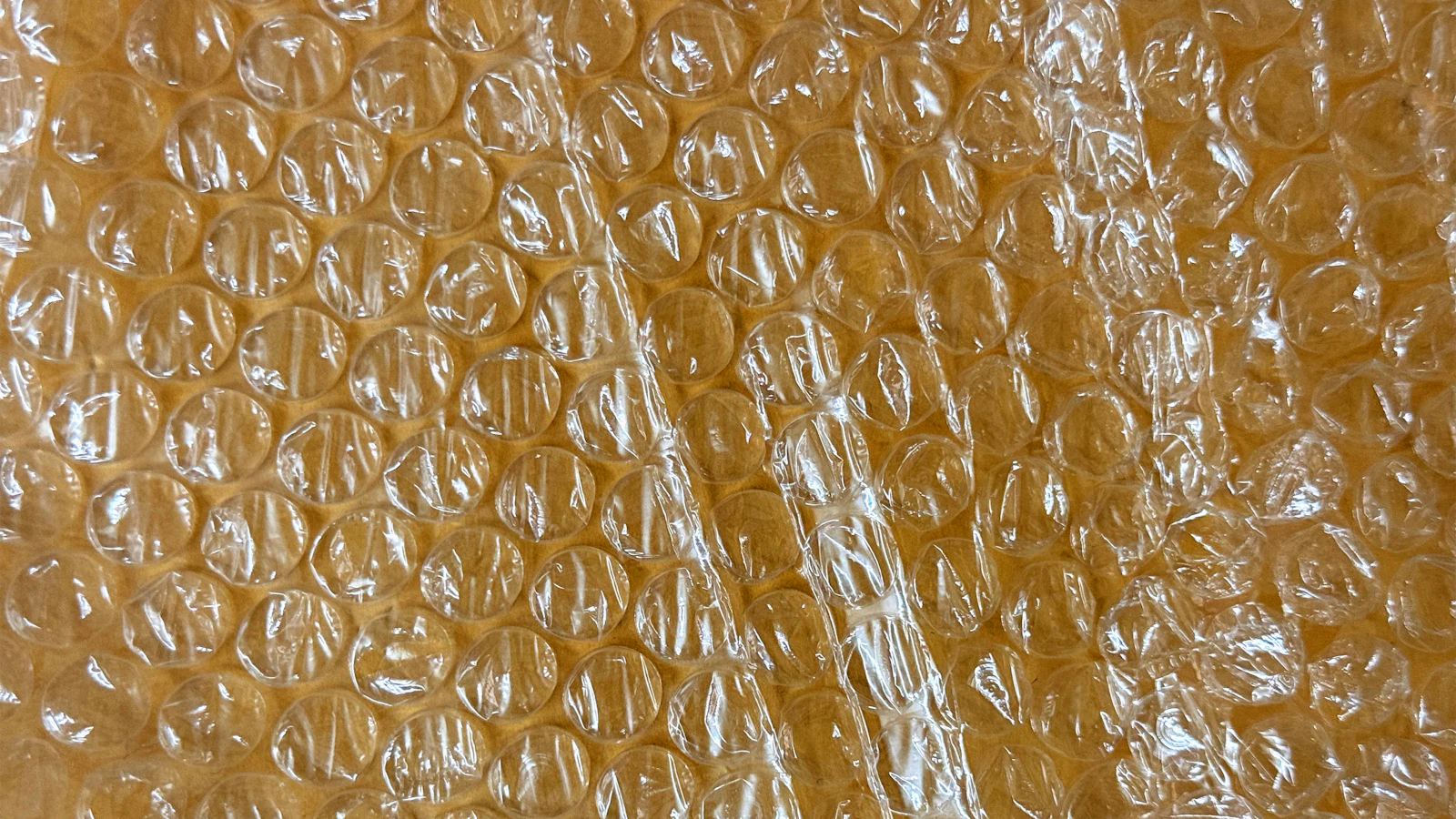
Is bubble wrap recyclable?
Bubble wrap can be recyclable when it is made from a polymer accepted in a functioning flexible-film recycling stream and the complete pack does not contain features that disrupt sorting or recycling. Under the PPWR there is no single EU-wide disposal instruction because collection systems differ between markets.
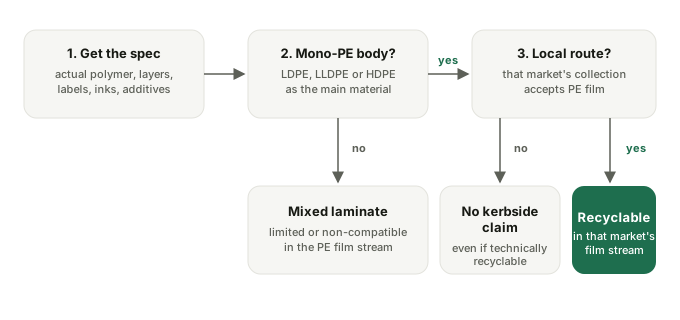
For PE films, RecyClass's current European design-for-recycling guideline lists LDPE, LLDPE and HDPE as fully compatible main-body materials in the PE flexible-film stream. That does not mean every sheet of bubble wrap qualifies. Labels, inks, adhesives, barriers, other polymers and additives can change the result.
The safest practical approach is therefore to verify the supplier specification first. Record the actual polymer and construction rather than declaring a packaging component simply as “bubble wrap”.
Is all bubble wrap made from LDPE?
No assumption should be made from the product name alone. Conventional flexible cushioning is often sold as polyethylene film, but formulations and multilayer constructions vary, so the material declaration should come from the packaging specification or supplier documentation.
If the component is PE film, RecyClass provides a useful technical benchmark. Its March 2026 natural PE guideline treats oriented and non-oriented LDPE, LLDPE and HDPE as fully compatible main-body materials, while several non-PE layers and other features can be limited or non-compatible.
Bubble wrap is not recyclable merely because it is flexible plastic. The exact polymer, attachments, additives and destination recycling stream determine the answer.
Can bubble wrap go in kerbside recycling?
There is no correct EU-wide yes or no. Waste collection is organised through national and local systems, and a flexible PE film that is technically compatible with recycling may still need a separate collection route in a particular market.
The technical-versus-local distinction matters for environmental claims. A business should not convert “technically recyclable PE” into a generic instruction such as “put this in household recycling” unless the relevant collection system actually accepts it.
The PPWR framework reinforces that broader view. Its definition of recyclable packaging requires packaging to be designed for material recycling and, once waste, capable of being separately collected, sorted into specific waste streams without harming other streams, and recycled at scale under the Regulation's timetable.
What makes PE bubble wrap easier or harder to recycle?
A simple mono-PE construction is easier to assess for recyclability than a mixed-material laminate. The RecyClass natural PE film guideline rates a film on how much of the pack by weight is compatible PE, with only limited room for other polymers such as PP attachments, so predominantly mono-PE designs rate best while mixed-material laminates fall to the limited or non-compatible ratings.
The rating above is a RecyClass methodology rating, not a PPWR legal grade. RecyClass also identifies potentially problematic features including certain multilayer polymers, metallisation, PVC, PET, degradable additives, some labels, barriers and inks.
Design sensitivity makes procurement data important. A buyer comparing two visually identical rolls should ask for polymer composition, colour, labels or printing, additives and any laminated layers rather than relying on a generic “recyclable plastic” description.
What PPWR grade does bubble wrap get?
Bubble wrap does not have one predetermined PPWR grade. Regulation (EU) 2025/40 Annex II separates PE flexible, PP flexible and other flexible plastic packaging into different assessment categories and establishes grades A, B and C from 2030.
Under the PPWR framework, grade A corresponds to at least 95% recyclability by weight, grade B at least 80% and grade C at least 70%. Packaging below 70% will be technically non-recyclable under that assessment. From 2038, grade C packaging may no longer be placed on the market.
The detailed design-for-recycling assessment applies to the packaging unit, not to the nickname “bubble wrap”. A PE film that performs well under a voluntary RecyClass method cannot simply be labelled PPWR grade A before the legal criteria are applied. See PPWR recyclability grades A, B and C for that distinction.
How can bubble wrap affect EPR fees?
Bubble wrap adds packaging material and therefore adds weight to the quantities a producer may need to report under national packaging EPR rules. Where a scheme applies a per-kilogram material contribution, using less film directly reduces the declared film weight for those shipments.
Some national schemes also apply eco-modulation. France's ADEME explains that household-packaging eco-contributions can be increased or reduced according to environmental characteristics through penalties and bonuses. The exact consequence therefore depends on the destination country's scheme and the complete packaging design, not an EU-wide bubble-wrap tariff.
PPWR also connects future EPR fee modulation with the Regulation's recyclability performance grades. That makes design-for-recycling increasingly relevant to both market access and producer-responsibility cost. Eco-modulation explained covers how those fee adjustments work.
Does bubble wrap count as empty space under PPWR?
Yes. This is one of the most important PPWR points for e-commerce packaging. Article 24 of Regulation (EU) 2025/40 explicitly says that space filled by bubble wrap counts as empty space, alongside paper cuttings, air cushions, foam, wood wool and polystyrene chips.
Under the PPWR, for grouped, transport and e-commerce packaging, the maximum empty-space ratio will be 50% from the later of 1 January 2030 or three years after the relevant implementing acts enter into force. The Commission must adopt the calculation methodology by 12 February 2028.
So replacing one filler with another does not solve an oversized-box problem. The first design question should be whether the outer packaging can be made smaller while still protecting the product. What void fill is explains the role of filler within the complete shipping pack.
Is paper bubble wrap automatically more recyclable?
No. Paper-based cushioning may fit a widely used fibre recycling route, but the complete construction still matters. Coatings, laminates, adhesives and mixed-material layers can affect whether a paper-based design is compatible with the relevant recycling process.
The same logic applies to plastic. A simple PE cushioning design can be compatible with a PE recycling stream, while a complex multilayer flexible pack can perform worse. Comparing alternatives therefore requires actual specifications rather than a paper-versus-plastic shortcut.
What are better alternatives to bubble wrap?
Under PPWR's design-for-recycling push, the best alternative depends on what the product needs protection from. A fitted corrugated insert can immobilise a regularly shaped product. Paper cushioning can protect surfaces or fill limited gaps. PE air pillows can provide lightweight gap filling where a flexible-film route exists. A smaller box may eliminate filler entirely.
The compliance objective is to reduce unnecessary material and empty space while preserving protection. PPWR design-for-recycling requirements should therefore be considered alongside transport performance, not after the protective format has already been fixed.
How should bubble wrap be declared for EPR reporting?
Declare the actual packaging material and weight required by the national EPR scheme. If the bubble wrap specification identifies PE flexible film, record it as the relevant PE packaging component rather than combining it with paper, rigid plastic or the outer box.
Keep the specification connected to the markets in which the packaging is placed on the market. National EPR systems can distinguish household and non-household packaging, use different material categories and apply different fee structures.
Gramta combines uploaded sales data with packaging specifications to calculate kilograms by material, market and household or business stream for EPR reports, while its compliance guidance supports country-specific registration and reporting workflows in markets such as Sweden, Germany, France, Italy, Spain and Poland. Gramta EPR compliance software connects packaging-material choices with the quantities businesses later need to report.
Sources:
Frequently asked questions
- Is bubble wrap recyclable?
- Bubble wrap can be recyclable when its actual polymer and complete design are compatible with an available flexible-plastic collection, sorting and recycling stream. RecyClass's current [PE flexible-film guidelines](https://recyclass.eu/protocols-guidelines/design-for-recycling-guidelines/packaging/) treat LDPE, LLDPE and HDPE main-body films as compatible with the PE film stream, subject to the rest of the packaging design.
- Can bubble wrap go in household recycling?
- There is no EU-wide bin answer. Collection systems differ by country and region, so businesses should not tell customers to put flexible film in kerbside recycling unless that instruction is valid locally. Recyclability under PPWR also considers collection, sorting and recycling, not material composition alone.
- What PPWR recyclability grade does bubble wrap get?
- There is no automatic PPWR grade for bubble wrap today. Regulation (EU) 2025/40 creates separate flexible-plastic categories and introduces [grades A, B and C from 2030](https://eur-lex.europa.eu/eli/reg/2025/40/oj), but the legal assessment depends on the complete packaging design and the detailed EU design-for-recycling criteria.
- Does bubble wrap count as empty space under PPWR?
- Yes. [PPWR Article 24](https://eur-lex.europa.eu/eli/reg/2025/40/oj) expressly states that space filled by bubble wrap counts as empty space when calculating the empty-space ratio for grouped, transport and e-commerce packaging.
Reviewed by Anton Kröger