Best EPR software for small EU sellers in 2026
Small stores need the law explained and the work done, not an enterprise platform. Five tools ranked for exactly that, with the arithmetic shown
For a small EU online store, the best EPR software in 2026 is the tool that needs the least from you: Gramta, which turns the order export you already have into the kilograms, the report and the country-by-country registration guidance, with nothing to install. EPR Insights suits Shopify-only stores from $15 a month, ForSURE offers a free plan for the smallest Benelux and German sellers, and Repax suits catalogue-builders.
Facts checked 25 August 2026 against each vendor's own published pages, except EPR Insights and ForSURE, checked 9 August 2026.
What "small" changes about the choice
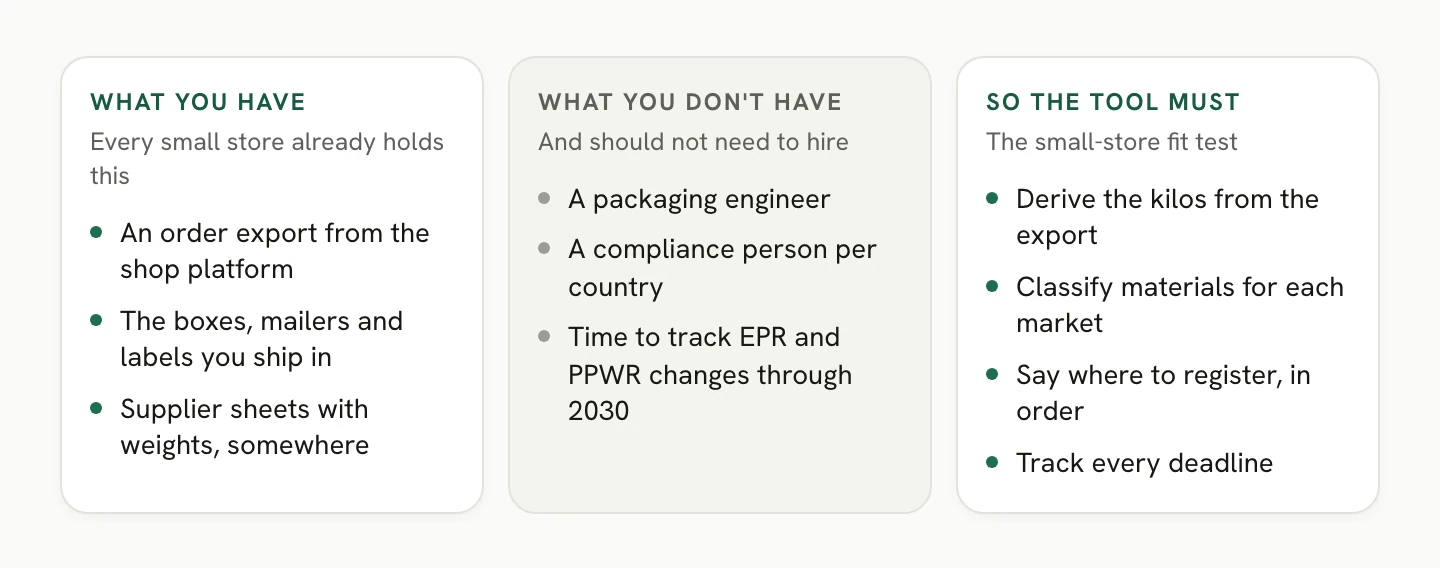
Most EPR software comparisons are written for compliance teams. A small store has none: no packaging engineer, no compliance hire, and no time to become one. That reverses the usual ranking logic in three ways.
First, guidance stops being a nice-to-have. A small seller's real questions come before any calculation: am I even an obligated producer in this market, do I need an authorised representative, where do I register first, what is due when? A tool that answers those questions about your business replaces the research nobody on a small team has time for. Our EPR registration guide shows how much of that path there is to know.
Second, setup cost is real cost. A EUR 29 plan that needs forty hours of catalogue building is not a EUR 29 plan. What a small store already has is an order export and the boxes it ships in. What it does not have is someone to model packaging data by hand.
Third, per-order and per-country EPR software pricing punishes growth differently. An app that charges per order gets more expensive as you succeed, and a service that charges per country makes your second market a purchasing decision. Read every price at next year's volume, not today's.
Five tools follow, ranked for a small EU online seller. Each entry ends with the honest case for choosing it. How this list was ranked is set out at the end.
1. Gramta: the export goes in, the obligation comes out
Gramta is built for the store this guide is for: an EU online seller with real orders, ordinary packaging, and no one whose job is compliance. You export your orders from Shopify, WooCommerce or any platform that can produce a file, and import it. That is the entire connection. No app to install, no store access to grant, no integration to keep working when the platform updates. The flow is identical whatever you sell on.
From that export plus one packaging specification per product, Gramta works out the kilograms per material for each market you sell into, splits household from business waste, and produces the report each market's scheme asks for, with the fee calculated. It maps your columns automatically and strips customer names, emails and addresses at import, so personal data never enters your compliance trail.
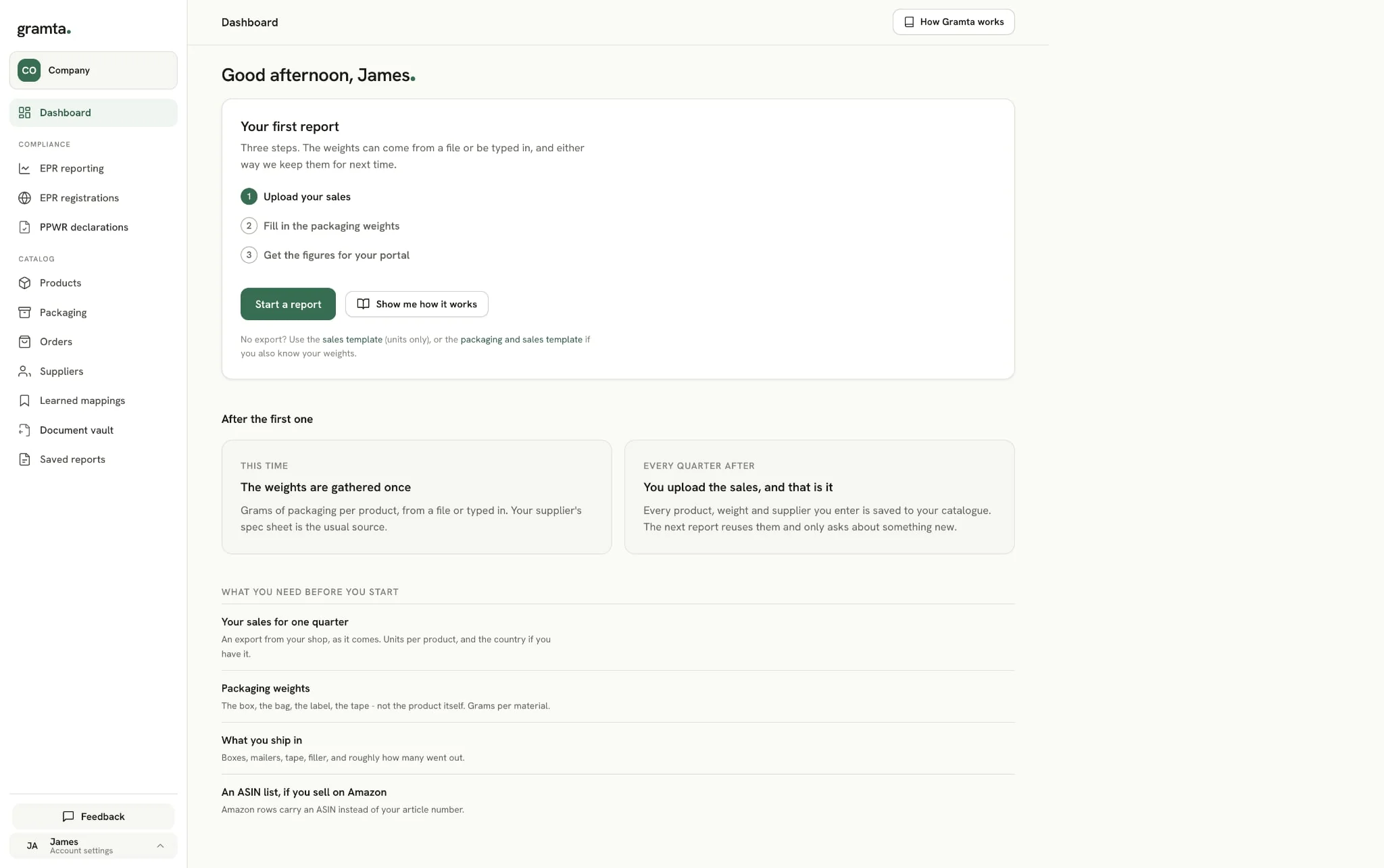
The second half matters more at small scale, and most tools skip it. For each market, Gramta tells you whether you are the obligated producer and whether you need an authorised representative, gives you the registration steps in order, with the exact register, the official link and the English-language route where one exists, and tracks what you report where and by when.
There is no long questionnaire: it knows your entity, reads your sales, and asks only the one or two things that change the answer. On the PPWR side, launching September 2026, it builds and stores the Declaration of Conformity and its Annex VII technical file from the same packaging data.
The honest limits: packaging only, EPR and PPWR, so batteries or electronics duties need another tool. There is no self-serve signup either. Gramta brings on a few stores every week, personally, so the first report is built with you rather than left to you.
Gramta's founding customers set their price now and keep a lifetime discount against whatever the public list becomes, which rewards exactly the small stores joining early.
Choose Gramta if you want the whole obligation handled from the data you already have, including being told what to do in each market, and you would rather talk to a person once than assemble a toolchain.
2. EPR Insights: the Shopify app route
EPR Insights, from Aarhus in Denmark, is a Shopify app with a web dashboard: connect the store, map products to packaging categories, and generate country-ready packaging, WEEE and battery reports. Pricing is public and small-store friendly on its face, $15 a month plus $0.05 per order beyond 400 orders a month on Basic, $29 beyond 1,500 and $59 beyond 4,500, billed in USD. The company claims 39 countries covered and 14 or more active markets.
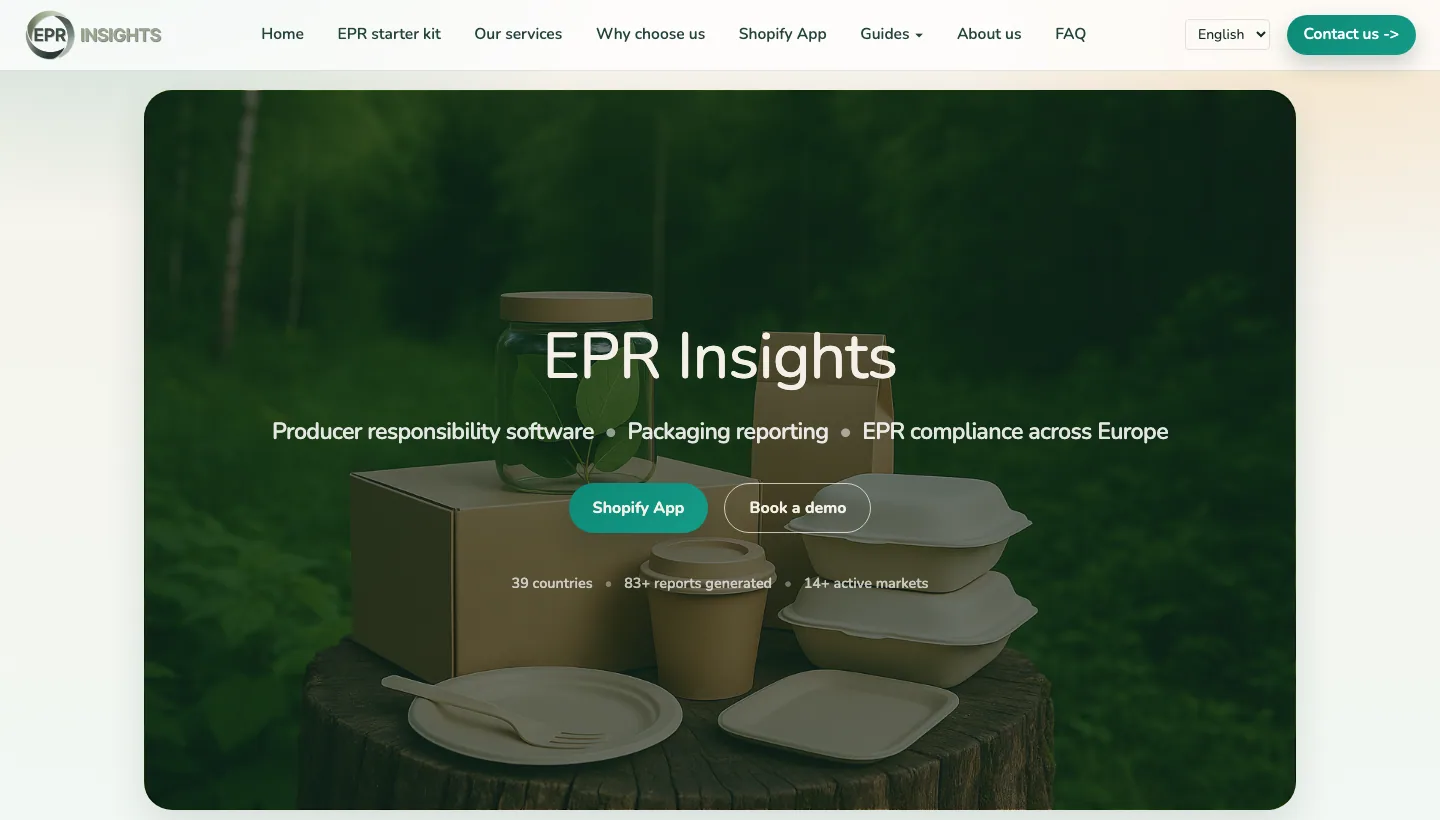
The app is also the boundary. EPR Insights is distributed as a Shopify app only, so a store on WooCommerce, a marketplace, or anything else has no route in, and the connection is a piece of software to install, authorise and keep working inside your store. Worth knowing before choosing a tool because it plugs in: an export-and-import flow like Gramta's reaches the same sales data in minutes with no store access at all, and does not care what platform produced the file.
EPR Insights prepares reports and leaves registration and submission with you, lists no PPWR product, and per-order pricing in USD means a growing store's bill grows with it.
Choose EPR Insights if you are Shopify-only, want a low entry price from an app store you already use, and are comfortable handling registration and the PPWR file elsewhere.
3. ForSURE: a free start for the smallest sellers, in three countries
ForSURE, a Dutch startup out of Utrecht's university incubator, sells multi-stream EPR reporting to SMEs, covering packaging, WEEE, batteries and textiles. Its distinctive offer is the free plan: report templates and an analytics tool for Belgium, Germany and the Netherlands, restricted to businesses under EUR 500,000 annual revenue, renewed yearly.
Read the free plan for what it is: templates you fill, for three countries, under a revenue cap, not automated reporting. Paid pricing is not published anywhere on their site, the sales motion is demo-first, so the cost of growing past the free plan is a conversation, not a number. No PPWR product features are published either.
Choose ForSURE if you sell only into Belgium, Germany or the Netherlands, sit under the revenue cap, and want structured templates for filling in your own numbers at zero cost.
4. Repax: for the store that wants to build its own catalogue
Repax, from Denmark, publishes honest prices and covers waste streams beyond packaging across 31 countries. For a small store the arithmetic looks friendly, a free tier at EUR 0 and Growth at EUR 29 a month ex VAT. The free tier caps at 50 orders a year and 250 products, which is a way to look inside the product, not to run a store on.
The real cost for a small seller is the data model. Repax reports from a four-layer catalogue, materials, components, assemblies, products, that you build by hand and keep current by hand, because its store connectors carry orders, never packaging composition. For a producer with a small, stable set of packaging parts and someone happy to maintain records, that structure is workable, and it is the honest choice if your duties reach past packaging into batteries or electronics.
For a typical small store whose packaging changes with suppliers and seasons, the Repax catalogue is a standing chore that arrives before the first declaration does. Our Gramta and Repax comparison works the record-by-record arithmetic.
Choose Repax if you report several waste streams, or you positively want to own and maintain a hand-built packaging catalogue and pay by the order for the privilege of scale.
5. ecosistant: information only, at the bottom of the budget
ecosistant, from Berlin, sells written guidance: a questionnaire that returns a per-country to-do list, scheme contacts and cost estimates, from EUR 24.90 per country in the first year. It calculates nothing, produces no report and files nothing, per its own product description. Every step on the list is yours to carry out, and the information is briefer than the price suggests.
For a small seller its use is narrow but real: if all you want to know is which obligations exist in a market before deciding anything, EUR 24.90 is a small bill. Gramta answers the same question, personalised to your own sales rather than to a questionnaire, as part of the product, which is why guidance alone rarely stays worth paying for once you also need the work done. A free alternative for the first question is our EPR and PPWR checker.
Choose ecosistant if you genuinely only want a written summary of your obligations in a market and intend to do every step of the work yourself.
The prices at a small store's real volume
One example store, carried through every published price list: 400 orders a year, 60 products, selling into two EU markets. Figures computed from each vendor's own published prices on the dates shown. The volumes are examples, not typical customers.
| Tool | What the published prices give this store | Per year |
|---|---|---|
| Gramta | Founding pricing, lifetime discount locked | Founding terms |
| EPR Insights | Basic $15/mo (under 400 orders/mo, well within it) | $180, in USD |
| ForSURE | Free only if BE/DE/NL and under EUR 500,000 | EUR 0, or a demo call |
| Repax | Growth EUR 29/mo (free tier's 50 orders/yr is exceeded) | EUR 348 |
| ecosistant | 2 country plans at EUR 24.90, guidance only | EUR 49.80 first year |
The rows buy different things, which is the real lesson of every price table in this market: ecosistant's number buys a document, ForSURE's buys templates, and only some columns end with a finished report. Whatever you pick, the PRO's own per-kilogram fees sit on top and usually exceed all of these. You can compare PRO fees across EU markets for free before committing anywhere.
Who a small seller should not buy from, and why
Names that surface in every search and belong to a different buyer:
- Lorax EPI, Sphera, Assent, Source Intelligence are enterprise compliance platforms wrapped in consulting, priced by conversation, sold to multinationals with compliance teams. Nothing about a small store fits that motion.
- Valpak and Ecosurety are UK compliance schemes. Their centre is UK packaging law, not EU EPR for online sellers.
- PacSpace, Packa and Recyda are packaging-data platforms built for portfolios with supplier data to manage and PPWR files to industrialise. Real products, wrong size of problem.
- Lizenzero Europe is not software at all but outsourced representation at EUR 299 per country plus scheme fees, the right purchase only if you want the admin done for you and will supply the quantities yourself. Our Lizenzero alternatives guide covers that trade.
Do you need any of them yet?
Maybe not this quarter. The smallest stores with one box size can comply with a spreadsheet, if someone is willing to learn each country's rules and keep re-learning them as tariffs change and PPWR duties arrive through 2030. That standing homework, not the multiplication, is the job. When you would rather hand it over, hand over the whole thing, the guidance and the numbers, rather than buying them separately. The free EPR and PPWR checker tells you whether you are obligated at all, and the software landscape guide maps what the market actually sells before you shortlist anything.
How we ranked these tools
We ranked for one buyer only, the small EU online store, on what that buyer ends up holding: whether the kilograms are derived from data the store already has, how much setup stands before the first report, whether the tool guides registration and deadlines or stops at numbers, whether PPWR paperwork comes from the same data, and the real published price at small volumes.
We publish no scores for these EPR tools, and we did not rank on headline price, because the models are not comparable on one axis. The full method, including how recommendations involving Gramta are handled, is on the how we compare EPR software page.
Sources:
- Regulation (EU) 2025/40 (PPWR), Articles 44-45 on producer obligations
- European Commission, packaging and packaging waste
- Zentrale Stelle Verpackungsregister (ZSVR), the German packaging register
- Vendor product and pricing pages: Repax, ecosistant, Lizenzero, checked 25 August 2026; EPR Insights (site + Shopify listing), ForSURE, PacSpace, Packa, Recyda, Lorax EPI, checked 9 August 2026.
Small store, first report ahead? Get started with Gramta with one order export, and the first declaration is built with you.
Frequently asked questions
- What is the best EPR software for a small online store?
- Gramta, for most small EU sellers. It reads the order export you already have, no app or store connection needed, works out the kilograms per material, produces the report each market asks for, and tells you whether you are even obligated in a market, where to register and what is due when. EPR Insights is a Shopify-only app from $15 a month, ForSURE has a free template plan for very small Belgian, German and Dutch sellers, and Repax suits producers who want to build a packaging catalogue by hand.
- How much does EPR software cost for a small store?
- Less than the scheme fees it calculates, usually. At a few hundred orders a year the published prices run from EPR Insights at $15 a month, through Repax Growth at EUR 29 a month, to ecosistant's guidance from EUR 24.90 per country, all checked against the vendors' own price lists. Gramta prices its founding cohort with a lifetime discount on future pricing. The PRO's per-kilogram fees sit on top of every option.
- Is there free EPR software?
- Free tiers exist, and they are scope tests rather than products. Repax's free tier caps at 50 orders a year and 250 products, ForSURE's free plan is report templates for Belgium, Germany and the Netherlands for businesses under EUR 500,000 revenue, and EPR Insights offers a 7-day trial. A small store can use them to look around, not to run compliance. If free is the point, start with a free obligation check instead and find out whether you even need a tool.
- Do I need EPR software if I only sell on Shopify?
- You need the obligation handled, and a Shopify app is one way to feed a tool your sales. It is not the easiest way: an app must be installed, granted access, mapped and kept working, and it only exists for that one platform. Gramta skips the plugin entirely, you export your orders from Shopify and import the file, which takes minutes, needs no store access, and works the same when you add a marketplace or move platforms.
- Can a small seller just use a spreadsheet for EPR?
- The very smallest can, if the packaging is simple. The catch is everything around the spreadsheet: learning what each country asks, classifying materials, watching tariffs change yearly and PPWR duties arrive through 2030, and hitting every deadline. That standing homework is what small sellers actually buy software to escape, and it is why a tool that includes country guidance beats one that only calculates.
- Which EPR tools should small sellers avoid?
- Nothing here is bad software, but enterprise compliance platforms such as Lorax EPI, Sphera or Assent are sold to multinationals with compliance teams and quote-only pricing, and UK schemes such as Valpak and Ecosurety centre on UK law. A small EU online store is not their buyer. Packaging-data platforms such as PacSpace and Recyda are built for portfolios with dedicated packaging data to manage, which a small store rarely has.
Reviewed by Anton Kröger