Gramta vs Repax: which EPR tool fits your store?
Two products, two starting points, and the honest case for each, checked against both companies' published pages
Repax and Gramta both turn packaging into EPR reports, from opposite ends. Repax gives you a four-layer catalogue, material, component, assembly and product, to build by hand and keep current, starting at EUR 0 a month and leaving the filing to you. Gramta reads your store's real sales, adds one packaging specification per product, fills in whatever detail is missing, and produces the report each of your EU markets asks for.
Gramta's EPR software prepares the report and guides you through registering and reporting in each market.
Facts checked 25 August 2026, against both companies' published product and pricing pages.
Where Gramta and Repax start from different ends
Picture a store with 40 products, four box sizes, two mailer types and a paper void fill. Every packaging-EPR report in Europe wants the same thing from that store: kilograms per material, per market, split between household and business waste. Nothing about that changes with the software. What changes is how much of it you assemble by hand.
Repax models the physical world first, manually. You create each material, then a component that uses it and carries a weight, then an assembly that lists those components, then attach the assembly to a product. Nothing in that catalogue arrives from your shop. Repax's store connectors pull orders and sales, never packaging composition, so every material, weight and part is typed in by a person and kept current by a person.
Gramta starts from the sale and works backwards. Your order export goes in, a mapping step reads whatever column names your platform produced, customer names and addresses are filtered out on the way through, and each product carries one packaging specification.
You upload the data you already have, the sales file and any material or supplier sheets you keep, in as many files as you have, and Gramta highlights what is missing rather than making you know it up front. If a market you sell into needs a plastic's polymer type, Gramta asks for that one field. If a market does not need it, Gramta does not ask. The questions follow where you actually sell, so you answer what matters and skip what does not.
The manual-catalogue choice versus the real-sales choice explains almost every other difference between the two products: how many records you create, who works out each country's rules, and how much of the second report is already done when you start it.
What Repax asks you to build before your first report
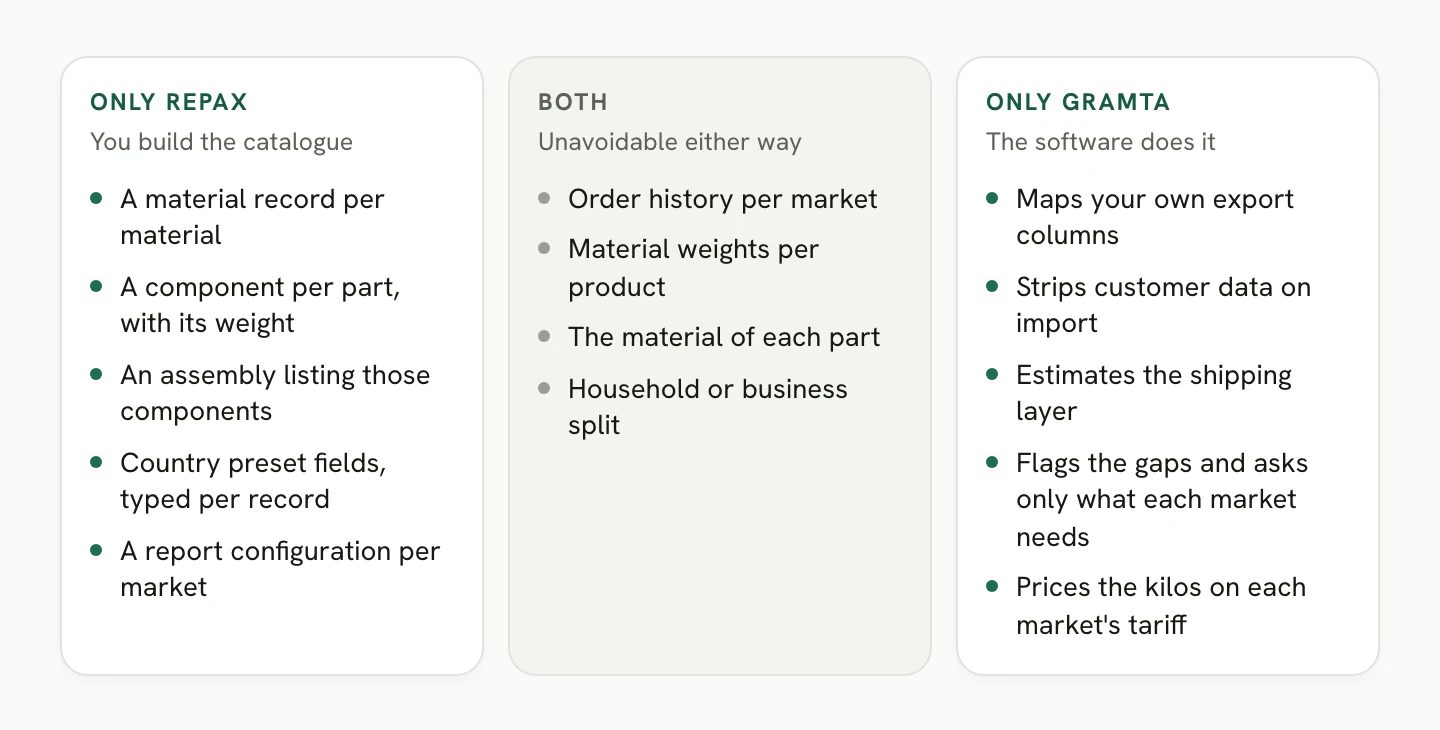
Repax Core is a catalogue you populate before it can report anything. Repax describes the shape on its own Core product page: "Each product breaks into the same four layers." In practice that means a material record per material, a component per part carrying its weight and stream, an assembly per packaging combination listing those components, and a product record referencing the assemblies.
Country preset fields sit on top of all of it, because a scheme's packaging category and the household-or-business destination of a shipment are not facts your shop system holds. So do report configurations, metered by plan: two on the free tier, ten on Growth, unlimited on Pro, per their pricing page.
Work the example. A 40-product store using six packaging combinations built from five materials and twelve distinct parts creates roughly five material records, twelve components, six assemblies and 40 product links before a single kilogram is declared, then sets preset fields across all of them.
None of those records arrives from an integration. Repax's integration list covers orders, "Shopify, WooCommerce, PrestaShop, Magento, CSV/Excel, Dinero, e-conomic, REST API" but no e-commerce platform stores the polymer of your film or the weight of your mailer, so the catalogue underneath is typed by hand.
The upkeep is the part that surprises people. Packaging changes constantly in e-commerce. A supplier switches film grade, a box size is added for a seasonal bundle, a mailer is swapped mid-year for a cheaper one. Each of those is a manual change to a component or a new assembly before the next declaration is right. The catalogue does propagate a correction across every product that shares a material, which is a genuine benefit at scale, but only once somebody notices the change and enters it.
Who Repax's model genuinely fits
The catalogue approach suits two profiles. The first is a producer with a small, stable set of packaging parts. When the mix is short and steady, entering it once is a light job, and there is a real logic to the structure: a component is defined in one place, so correcting it updates every assembly that uses it. For a workshop that reuses the same handful of parts across its range, that is tidy.
Gramta fits that producer too. You enter one packaging specification per product once, it is reused every quarter, and a part that changes is still one edit in one place, so the same small stable catalogue takes less setting up and no ongoing maintenance between reports. The reuse is a feature of the data model, not a reason to build the catalogue by hand.
The second profile is a producer with duties beyond packaging. If you place batteries or electronics on the market as well, one product record serving several streams saves duplicated work, and Gramta will not do it. Gramta is packaging only, EPR and PPWR, deliberately.
The trouble comes as the catalogue grows. The typical store selling into Europe has no packaging engineer, a few dozen to a few hundred SKUs, and packaging that changes with suppliers and seasons. At that point the by-hand catalogue is no longer a one-time job, it is a standing chore, and the work-per-report is what decides the tool. That is where Gramta fits.
How much data entry does Gramta need?
Gramta asks for the same physical facts and fewer records. A product gets one packaging specification: each material, its weight, and how it is classified. Composite materials and the household-or-business distinction are handled inside that specification rather than as separate component records. Transport packaging is estimated as a layer across orders, so the box you ship in is described once, not attached to 40 products.
In practice it runs as a loop you repeat whenever you need a report. You upload your latest sales export, Gramta maps the columns and remembers the mapping, and it walks you through the specification, stopping to ask only where something is missing or a market needs a detail you have not given yet. At the end you have the report for each country you sell into. Next quarter you upload again and most of the answers are already there.
Personal data never reaches an output. Customer names, emails and addresses are filtered out at import, and Gramta never asks for them in the first place.
Where Gramta is better than Repax
The real-sales model pulls clearly ahead of a catalogue you build by hand in the following places.
Your quantities come from real sales
Choose Gramta when the declared kilograms should follow what you actually shipped. Gramta reads the order export and multiplies the orders you shipped by the packaging spec, so the numbers move with your trading year without anybody re-estimating them.
Upload what you have, and Gramta fills the gaps
You do not have to learn what each product and market needs before you start. Materials, weights, composites and the household-or-business split live in one spec per product. There is no component library to construct first, and a supplier's film change is one edit in one place. You upload the sales file and any material sheets you keep, and Gramta flags what is missing and asks only for the fields the markets you sell into actually require.
Your columns map themselves, and personal data stays out
Gramta's mapping engine reads whatever headers your platform produced, shows you each match, and remembers the mapping for next quarter. Customer names, emails and addresses are removed at import and never reach an output, which matters the first time someone asks what customer data your compliance tool holds.
The fee is calculated on each market's tariff
Where Gramta covers a market in depth, the current rates and composite rules are built in, so the fee is worked out on that market's tariff rather than left for you to configure. Under eco-modulation the grade you declare changes what you pay, so getting the classification right is worth money every reporting period.
Where Gramta also handles registration and reporting
Registration and reporting are guided, country by country
Gramta does not stop at the numbers. For each market you sell into, it works out whether you are the obligated producer there and whether you need an authorised representative, from where your selling company is established and who you sell to. It then gives you the steps to register in the right order for that country, the authority, the register and the scheme, who to contact, each with the official link and the English-language route where one exists, and it tracks what you report and by when.
Gramta asks only the one or two things that actually change the answer for a market and works the rest out from what it already holds, so its guidance replaces a questionnaire about your own obligations. Later, the same material profiles could point you to the PRO likely to cost you least as you open up new markets.
Gramta vs Repax: what you actually end up with
Feature checklists flatter everyone. The table below is the outputs version: what the buyer actually ends up holding, from each product's own published description.
| What you end up with | Repax | Gramta |
|---|---|---|
| Per-material kilograms per market | Yes, from catalogue and order data | Yes, from order export and packaging spec |
| The report in each scheme's own shape | Report configurations you build per market | The report each market asks for |
| The fee, calculated | Rate-based formulas you configure | Calculated on each market's current tariff |
| Registration and producer guidance | No | Guided per country: obligation, where to register, deadlines |
| Submission to the scheme | No | No |
| PPWR Declaration of Conformity | Yes, with QR verification and versioned PDFs | Launching September 2026, with Annex VII file and QR page |
| Waste streams covered | Packaging plus some non-packaging streams | Packaging only, EPR and PPWR |
| Countries | 31 published | All EU markets |
| Audit trail | Order specs frozen at sale | Evidence pack from kilogram back to order |
| Self-serve sign-up | Yes, from EUR 0 | No, a limited number of stores each week |
Who submits your EPR report, you or the software?
Who submits the EPR report is the question buyers ask last and should ask first, because almost every packaging tool on the market prepares numbers rather than files them. Repax answers it plainly on its own Core page: "Core prepares the filing. Submission to each PRO or national registry happens outside Core today." So the registration, and the button in each portal, stay with you.
Preparing is not a small thing. The kilograms are the hard part. But it leaves a chain of steps with dates attached: register in the right country, with the right scheme, then report the right figure before each deadline. Software that stops at a spreadsheet leaves all of that to you.
The registration and reporting gap is the half Gramta does not leave to you. It produces the report each market asks for, and around it guides you through registering in that country and tracks what you report and when, using the kilograms it already holds from your sales. Neither product signs or submits anything for you, and neither should. The producer is the legal filer, everywhere in the EU. But there is a wide gap between a tool that hands you numbers and a tool that also tells you where to take them.
If you are choosing between tools, ask each vendor the same two questions, who presses submit and what happens on the deadline, and compare the answers rather than the feature grids. The EPR reporting software guide sets out the rest of the checklist.
Where Repax beats Gramta
Two things Repax has that Gramta does not.
You can open it for free and click around
Repax Core lists EUR 0 a month so a very small seller can open the product without talking to anyone. It is capped at 50 orders a year and 250 products, which is not a plan you could file a real store on, but a cheap way to see the inside and test whether you have an obligation at all. Gramta has no free tier. What you get instead is a person who personally onboards you until your first report is out, rather than a login and an empty catalogue.
Streams beyond packaging on one record
Repax has functionality for non-packaging streams such as batteries and electronics, so if you sell electronics in a box, one product record can serve both obligations. Gramta is packaging only, EPR and PPWR, and always will be.
Choose Repax if you would rather build a packaging catalogue from scratch by hand and own every record you create, knowing you will also maintain every record and work inside Repax's structure to do it, or if you report waste streams beyond packaging. If the appeal is starting today at zero cost without a conversation, weigh it honestly. The free tier is capped too low to run a store on, and the "without a conversation" part is exactly where Gramta's guided onboarding does the work for you instead.
What does Repax actually cost at your volume?
Repax publishes its prices, which deserves credit and makes the arithmetic below possible. Repax Core lists EUR 0, EUR 29 and EUR 59 a month ex VAT, checked on the Core pricing page 25 August 2026. Pro add-ons run at EUR 12 a month per extra 2,500 orders a year, EUR 5 per extra 1,000 products, EUR 5 per extra user and EUR 2 per extra gigabyte of storage.
A headline price of "from EUR 0" is not what a growing store pays. The table below applies the same price list to four shapes of business. Every figure is computed from Repax's own published tiers and add-ons. The volumes are examples, not typical customers.
| Example store | Repax plan | Per month | Per year |
|---|---|---|---|
| 400 orders, 120 products, 1 user | Growth | EUR 29 | EUR 348 |
| 3,000 orders, 900 products, 2 users | Pro, +1 order add-on | EUR 71 | EUR 852 |
| 12,000 orders, 4,500 products, 4 users, 5 GB | Pro, +4 order, +2 product, +2 user, +2 GB | EUR 131 | EUR 1,572 |
| 120,000 orders, 6,000 products, 5 users, 10 GB | Pro, +48 order, +3 product, +3 user, +7 GB | EUR 679 | EUR 8,148 |
The bottom row is a busy store, and it reaches EUR 8,148 a year without a single sales conversation, almost all of it the per-order add-on stacking up. None of these figures include the scheme's own fees, which are the larger number. On a typical rigid-plastic tariff, a tonne of plastic packaging costs more in fees than any software licence here.
Against those numbers, Gramta's own price sits with the founding cohort rather than on a public list. A limited number of stores onboard each week, onboarding runs until your first report is out rather than ending at a login, and the rate a founding customer starts on is the rate they keep.
Should you choose Gramta or Repax for EPR and PPWR?
Four store shapes cover most of this market. Find yours.
The small single-market store
One country, a few hundred orders a year. Gramta. The report lands finished rather than half-built, the fee is the number you will actually be invoiced, and Gramta tells you whether you even need to register in that market before you spend anything on software. If you only need to find out whether you are in scope at all, the free EPR and PPWR checker needs no signup, and Repax's free tier caps at 50 orders a year.
The big single-market store
One country, thousands of orders, dozens of SKUs. Gramta. At this size the packaging mix has stopped being uniform and the reporting cadence has usually tightened. Deriving quantities from real orders, and having the classification and the deadlines handled for you, is worth more than a component library you have nobody to maintain.
The small multi-market store
A handful of countries, low volume in each. Gramta covers every market you sell into from one upload, and tells you which of them you are actually obligated in. The answer is often fewer than you feared, because thresholds and marketplace exemptions are read from your real volumes. Repax has the wider published country count and a working free or EUR 29 tier while your volumes are small, so take it if you would rather assemble each market's catalogue yourself.
The big multi-market store
Many countries, high volume, multiple duties. If your obligations extend past packaging into batteries or electronics, a multi-stream tool such as Repax handles those from one product record, and no framing changes that. If your duties are packaging only, the deciding factor is who does the classification, registration and deadline work at that scale across every market, which is exactly what Gramta's real-sales data, applied tariffs and per-country guidance are built to carry.
What matters more than your store's size?
Two needs settle the choice whichever of the four shapes you are:
- You need the PPWR declaration of conformity and the technical file behind it. Gramta's declaration, its Annex VII technical file and a QR-verifiable public page launch in September 2026, and leave you as the signatory, which the law requires. The guide to signing a PPWR declaration of conformity explains what you are attesting to.
- You need to buy today, with a card, without talking to anyone. Repax. Gramta brings on a small, fixed number of stores every week, personally, which is a real difference on the day you need something, though it is also how the registration and reporting guidance gets set up around your actual data rather than left for you to work out.
How we compared Gramta and Repax
Every fact about Repax here comes from its own published product and pricing pages, quoted and dated, and re-checked each quarter. Gramta's own capabilities are described from its product. The full method, what we rank on and how we source it, is set out on our how we compare EPR software page.
Sources:
- Regulation (EU) 2025/40 (PPWR), Article 39 on the declaration of conformity
- European Commission, packaging and packaging waste
- An example national packaging tariff (NPA fee tables)
- Repax product and pricing pages (Core, Core pricing, Declare), checked 25 August 2026.
Want your own numbers rather than a comparison? Work through the EPR reporting software checklist, check whether you need EPR and PPWR at all, or get started with Gramta and bring one order export.
Frequently asked questions
- Which is better for my store, Gramta or Repax?
- For most online sellers shipping into the EU, Gramta. It reads your real sales, fills in the packaging details it needs, produces the report each market asks for, and guides you through registering and reporting country by country. Repax makes sense in two narrower cases: you want to build and maintain a packaging catalogue by hand from scratch, or you report non-packaging streams such as batteries or electronics. Neither is the typical packaging-only store.
- Why choose Gramta over Repax?
- Because Gramta does the work Repax leaves with you. Repax gives you an empty four-layer catalogue to build and maintain by hand, then prepares numbers you still have to file. Gramta reads the sales you already have, asks only for the packaging details a given market needs, produces that market's report, and then tells you whether you are even obligated there, where and how to register, and what to report by when. You get the numbers and the path to file them, across every EU market you sell into, from one upload.
- Is Repax free?
- No, not in any way you could run a store on. Repax Core lists a EUR 0 tier but it caps at 50 orders a year and 250 products, which is enough to open the product and test whether you have an obligation, not to file for a real store. The working Core plans are EUR 29 and EUR 59 a month ex VAT, plus add-ons that climb with your order volume.
- Does Gramta work across the EU?
- Yes, across every EU market you sell into. Gramta produces the kilograms-per-material report each market's scheme asks for, and guides you country by country through whether you are an obligated producer there, where and how to register, and what to report by when. It works from your real sales, not one market at a time.
Reviewed by Anton Kröger