Repax alternatives: 4 options compared for 2026
Choose the replacement by the work you want removed, not by the nearest feature list.
Gramta's EPR software is the best Repax alternative for most EU online sellers in 2026 because it turns an order export and product packaging specifications into traceable material quantities while also guiding the country process. The right replacement depends on which Repax job you are replacing, because ForSURE, PacSpace and ecosistant each solve a narrower and different problem.
Facts checked 31 August 2026 against the companies' own published pages, using the vendor check dates stated below.
For readers who already know the choice is between the first two products, the Gramta and Repax comparison goes deeper into the workflow difference. This guide is for the broader question of what else could replace Repax and why.
What do you get from Repax?
Repax sells a catalogue-based EPR workflow. Its Core product is built around four layers: materials, components, assemblies and products. The user builds that packaging catalogue and keeps it current. Repax's store connectors for Shopify, WooCommerce, PrestaShop and Magento, plus CSV or Excel and REST API routes, carry orders and sales data. They do not carry the packaging composition itself.
Repax's pricing pages list Core at €0, €29 Growth and €59 Pro per month ex VAT. The free tier is limited to 50 orders a year, 250 products and one user. Pro includes 2,000 orders a year and 3,000 products. Published add-ons are €12 a month per additional 2,500 annual orders, €5 per additional 1,000 products, €5 per additional user and €2 per extra GB.
Repax's pricing matters because a store does not only choose a tier. It chooses a tier plus the catalogue size and order capacity it needs. A store with 6,000 annual orders and 4,000 products, for example, moves beyond the base Pro limits and needs paid add-ons.
Repax also draws a clear line around the last step. Its own Core page says, "Core prepares the filing. Submission to each PRO or national registry happens outside Core today." In other words, Core prepares the numbers but the producer still carries the report into the scheme or register.
PPWR declarations are a separate Repax product. Repax Declare is priced at €0, €29 and €59 a month with limits of 1, 100 and 500 declarations. Repax describes the one-declaration free tier as an evaluation option. Repax states a 31-country footprint and some functionality for waste streams beyond packaging.
The useful comparison is therefore not simply "what has the same features as Repax?" It is which part of this workload you want the replacement to take away. That is the broader distinction behind EPR reporting software.
Why do sellers look for a Repax alternative?
The packaging catalogue is another dataset to build and maintain
Repax's four-layer model is explicit. Materials become components, components become assemblies, assemblies become products. That can create structure, but the packaging composition remains a user-maintained catalogue. The store connector moves order and sales data, not the material makeup of each package.
A seller looking for an alternative may therefore be trying to remove the second catalogue rather than replace it with another version. If the packaging around a SKU changes, somebody has to update the model before the next report can be trusted.
The working price can grow beyond the headline tier
Repax Pro includes 2,000 annual orders and 3,000 products. Above that, published monthly add-ons apply. A growing catalogue can therefore increase the software bill even when the underlying compliance job has not changed conceptually.
The free tier illustrates the same point at the other end. 50 orders a year is fewer than one order a week. It is useful for testing the model, not for running most active stores.
EPR calculations and PPWR declarations are priced separately
A seller that needs both Core and more than the evaluation allowance in Repax Declare is buying two products. Repax Declare starts with one free evaluation declaration and then moves to €29 or €59 a month for 100 or 500 declarations.
For a store that sees EPR reporting and PPWR documentation as one packaging-compliance job, a separate product boundary can be a reason to look elsewhere.
Submission still belongs to the producer
Repax's own Core wording says submission to the PRO or national registry happens outside the product. A seller can therefore finish the Core workflow and still need to know where to register, which portal to use, which sequence applies and when the resulting numbers must be submitted.
A Repax alternative is most meaningful when it changes that remaining workload, not merely when it redraws the same calculation screen.
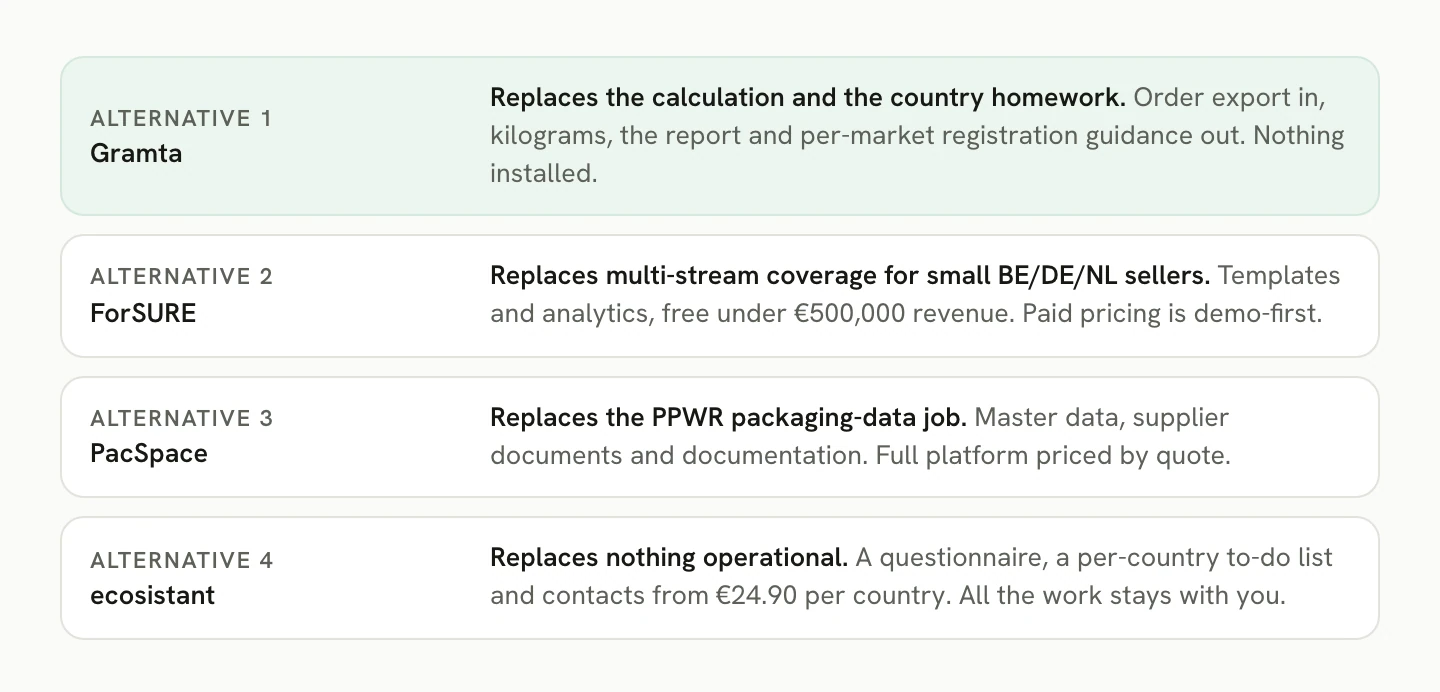
Alternative 1: Gramta
Gramta is the closest alternative in this list for an online seller that wants the packaging calculation itself to become easier while also removing country-by-country research.
The seller exports orders from Shopify, WooCommerce, Amazon, a marketplace or another system. Nothing is installed or connected. Gramta maps the incoming columns and strips customer names, email addresses and postal addresses on the way in. One packaging specification per product then combines with the real orders to produce kilograms per material and market, household and business splits where relevant, fee calculations and the report shape each market's scheme asks for. Each result remains traceable to the orders behind it.
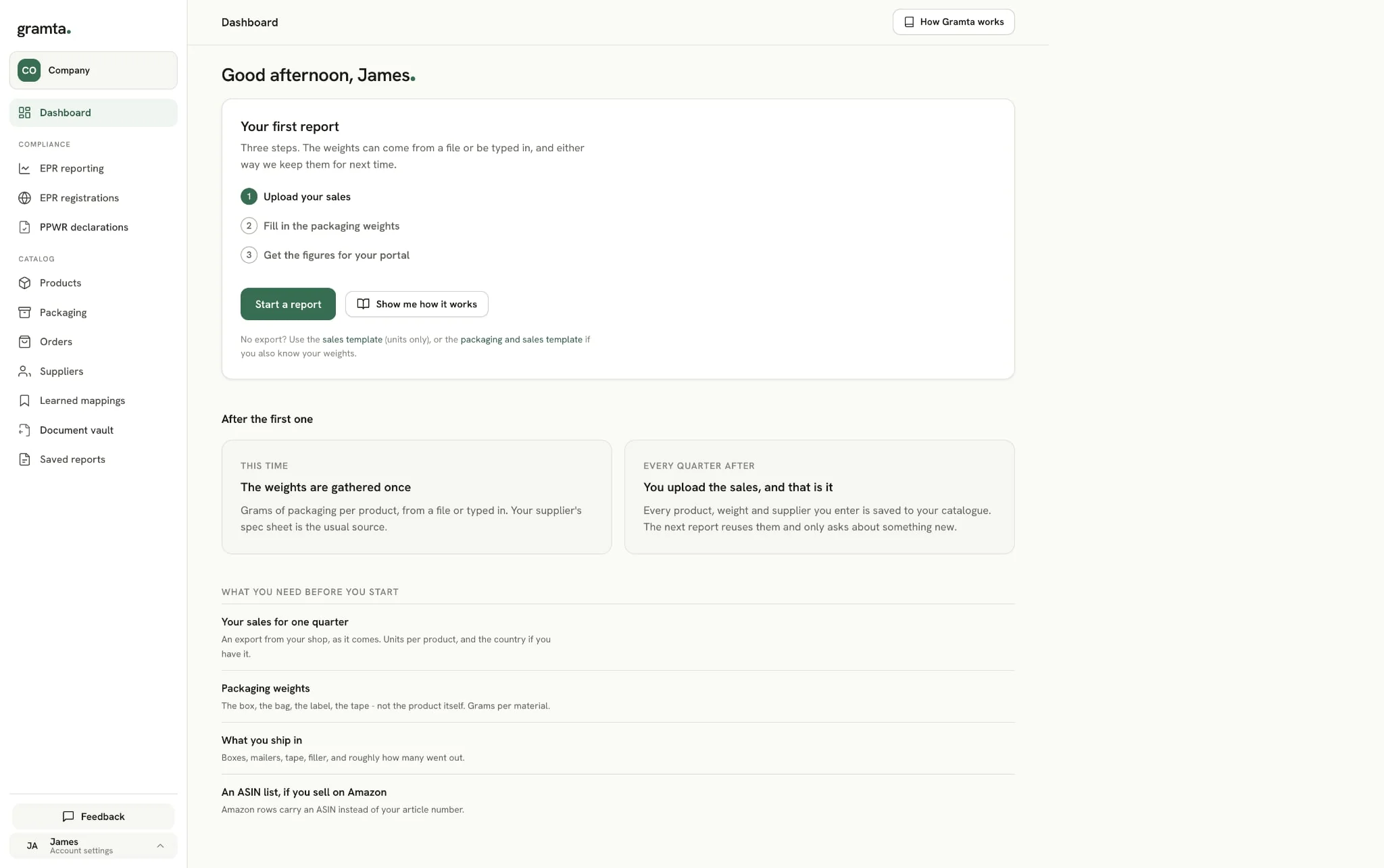
The second half is the guidance layer. Gramta tells the producer whether it is the obligated entity for a market, whether an authorised representative is relevant, the correct order of registration steps, the exact authority, register and PRO, official links, English-language routes where they exist, and what is due when. A seller can separately compare PRO fees across EU markets rather than hard-coding one scheme choice into its packaging model. The EPR and PPWR checker also answers the first scope question before a seller commits to a workflow.
The declaration work arrives with the PPWR module in September 2026, when the EU declaration of conformity and Annex VII technical file will be built and stored in Gramta, a QR code on each declaration opening a public verification page.
Gramta is onboarding its founding cohort, and founding customers keep a lifetime discount against the public pricing introduced later.
Gramta is packaging-only, so a business that wants one tool for batteries, WEEE and textiles should choose a broader stream product. It also has no instant self-service signup. A limited number of stores are personally onboarded each week so the first report is built with the customer.
Choose Gramta over Repax if your main goal is to remove the hand-maintained packaging catalogue and combine order-level calculations with sourced country guidance, accepting assisted onboarding and a packaging-only scope.
Alternative 2: ForSURE
ForSURE is the alternative for a different Repax user: the SME whose main reason for choosing Repax was broader waste-stream coverage rather than the packaging workflow alone.
ForSURE's published scope covers packaging, WEEE, batteries and textiles. Its free plan provides report templates and an analytics tool for Belgium, Germany and the Netherlands, and is restricted to businesses below €500,000 annual gross revenue. Eligibility is renewed yearly.
The important limitation is the output. The free product is a set of templates the user fills, not automated reporting. Paid pricing is not published on ForSURE's site and the sales route is demo-first. No PPWR product features were published on the checked date.
ForSURE's template-only output still makes it a sensible shortlist option for a small Benelux or German business that needs several EPR streams and can accept template work. It is not the stronger choice for a seller whose main problem is turning a large order export into traceable packaging quantities across the EU.
Choose ForSURE over Repax if multi-stream EPR across Belgium, Germany and the Netherlands matters more than packaging automation, and you qualify for the free plan or accept demo-first pricing and template-based work.
Alternative 3: PacSpace
PacSpace fits the seller whose main attraction to Repax was PPWR documentation rather than EPR reporting. PacSpace positions itself as "the packaging data platform, built for PPWR" and uses a three-module chain of materials, packaging and products.
Its public pages describe AI extraction from supplier declarations and technical data sheets plus packaging fee calculation per product. Full platform and advisory pricing is not published and is quoted separately. Its PIA PPWR assistant lists a €29 a month Pro tier.
PacSpace Light shows the data model without a login. Building one packaging unit asks for packaging type, component type and detailed material fields including surface weight in g/m², unit weight, plastic structure and type, plus a PPWR Article 5(4) heavy-metals self-declaration.
Its centre of gravity is packaging master data and PPWR documentation, with fee calculation advertised on top: its pages describe multi-country PRO reporting and exportable reports for PRO submission with sold volumes per market supplied as an input. It publishes no country list, no registration guidance and no full-platform pricing, and has no self-service signup for the full platform. A seller evaluating it should therefore decide whether the main problem is PPWR packaging data or the whole order-to-registration workflow. For that narrower purchasing question, see what to look for in dedicated PPWR software.
Choose PacSpace over Repax if PPWR packaging master data is the job you most want to improve, accepting quoted full-platform pricing and no published country list for EPR reporting.
Alternative 4: ecosistant
ecosistant is the alternative when the buyer never needed calculation software in the first place and mainly wanted to understand what applies in each country.
Its Self-Service product starts at €24.90 per paid country in the first year and €17.90 on renewal. Germany is free. The 30-country package costs €399 in the first year and €299 on renewal.
The output is a questionnaire-based per-country to-do list, scheme contacts and cost estimates. ecosistant calculates no packaging weights, produces no report and files nothing. A separate Premium Service, priced by quote, has staff handle registration and volume reporting. Its published footprint is 30 countries.
For a seller that only wants an obligation checklist before deciding how to comply, that smaller product can be enough. It is a poor substitute for Repax if the goal is to replace the packaging calculation, because every material quantity and report still has to be created elsewhere.
Choose ecosistant over Repax if you only want country guidance and contacts, accepting that Self-Service leaves all packaging calculations, reports and submissions with you.
Repax and its alternatives, side by side
| Output or constraint | Repax Core | Gramta | ForSURE | PacSpace | ecosistant |
|---|---|---|---|---|---|
| What you get | Catalogue-based EPR calculation | Order-to-material calculation, report workflow and sourced country guidance | Multi-stream templates and analytics on free plan | Packaging master data and PPWR-focused platform | Country to-do list, contacts and cost estimates |
| Published price | €0, €29 or €59 monthly ex VAT plus add-ons | Founding pricing (lifetime discount) | Free for eligible sub-€500k businesses in BE/DE/NL, paid price not published | Full platform quoted separately, PIA Pro €29/month | From €24.90 per paid country first year, 30-country package €399 |
| Where quantities come from | User-maintained four-layer catalogue plus sales data | Order export plus one spec per product | User fills report templates | Materials, packaging and product master data | No packaging-weight calculation |
| Registration guidance | Submission happens outside Core | Sourced per-market sequence, official links and deadlines | No | No | Questionnaire-based to-do list and scheme contacts |
| Who files | User outside Core | Customer, using the generated report | User on the free template plan | Not stated | User, or Premium Service staff by quote |
| PPWR declaration of conformity | Separate Repax Declare at €0, €29 or €59 monthly | Launching September 2026 in the integrated workflow | No | PPWR-focused packaging data and documentation | No |
| Countries | Claims 31 countries | All EU markets | Free plan: Belgium, Germany, Netherlands | Not published | 30 countries |
| Streams | Packaging plus other waste streams | Packaging EPR and PPWR only | Packaging, WEEE, batteries and textiles | Packaging and PPWR data | Compliance information |
What do the Repax alternatives cost?
The sellers are examples, not typical customers. The table compares published software or service price mechanics, not PRO fees. Where a vendor does not publish a full-platform price, the table says so rather than inventing one.
| Example | Repax Core | Gramta | ForSURE | PacSpace | ecosistant Self-Service |
|---|---|---|---|---|---|
| What the money buys | Catalogue-based EPR calculation | Calculation, report workflow and guidance | Templates and analytics on free plan | Full platform by quote, PIA is a PPWR assistant | Information and to-do list |
| Belgium seller, 40 orders/year, 100 products, under €500k revenue | €0 within free caps, a scope test rather than an operating plan | Founding pricing (lifetime discount) | €0 if eligibility conditions are met, with templates the user fills | Full platform quote, PIA Pro alone €29 × 12 = €348/year | 1 × €24.90 = €24.90 first year |
| BE + DE + NL seller, 1,800 orders/year, 3,000 products, under €500k revenue | €59 × 12 = €708/year ex VAT | Founding pricing (lifetime discount) | €0 if eligibility conditions are met, limited to templates and analytics | Full platform quote, PIA Pro alone €348/year | Germany free + Belgium €24.90 + Netherlands €24.90 = €49.80 first year |
| 30-market seller, 6,000 orders/year, 4,000 products | €59 + €24 for two order add-ons + €5 for one product add-on = €88/month, or €1,056/year ex VAT | Founding pricing (lifetime discount) | Free plan does not cover the wider footprint, paid pricing is by demo | Full platform quote, PIA Pro alone €348/year | 30-country package = €399 first year |
Repax Declare is separate from the Core figures above. A seller that also needs more than the one-declaration evaluation tier should add the relevant €29 or €59 monthly Declare tier to its own comparison.
Where Repax still has an edge
Repax publishes clear self-service Core prices
A buyer can see the €0, €29 and €59 Core tiers without booking a call. That is a real budgeting advantage over Gramta's assisted founding-cohort onboarding, ForSURE's unpublished paid price and PacSpace's quoted full-platform price. The cost of that transparency is that the buyer still has to model the catalogue limits, paid add-ons and separately priced PPWR product to understand the working price.
Repax covers some functionality beyond packaging
Repax states that it has functionality for some waste streams beyond packaging. That is useful for a buyer that wants a broader scope than packaging-only Gramta. The cost is that Repax's packaging workflow still relies on the hand-built four-layer catalogue, and its PPWR declarations remain a separate product.
What should you do before switching from Repax?
First, separate your compliance records from the software model used to create them. Keep copies of product packaging specifications, material mappings, historical reports, tariff source dates, producer or registration numbers, PRO membership details and evidence supporting already submitted figures. A new tool should not require the business to forget why last year's declaration had the number it did.
Second, decide whether the replacement should preserve the Repax catalogue structure or eliminate it. If the goal is to move to an order-export workflow, the valuable source data is the product packaging specification and real sales history, not every layer of the old software model.
Third, do not assume changing software cancels a producer registration or PRO relationship. Record the producer IDs, portal access and contracts held in the business's name, and separately verify any power of attorney or managed-service appointment before changing providers.
Fourth, test one completed reporting period in the new workflow before relying on it for the next deadline. Reconcile kilograms per material, market totals and scheme categories against the previously accepted period. The aim is to identify mapping differences before they become a live submission problem.
Finally, decide whether fee comparison should remain independent of the software vendor. Gramta keeps a public route to compare PRO fees across EU markets, which makes it easier to question a scheme choice without rebuilding the underlying packaging data.
How we ranked
We ranked the alternatives by the job a seller can stop doing after switching. Gramta ranks first because it changes both the packaging-data workflow and the country-guidance workload. ForSURE ranks for multi-stream SMEs, PacSpace for PPWR-focused master data, and ecosistant for information-only buyers. Those are different replacement jobs rather than four copies of Repax.
We did not rank on headline price because the published numbers buy different outputs. A €24.90 information subscription, a free template plan, a €29 PPWR assistant and a catalogue-based EPR calculator are not interchangeable. Our complete approach is set out on the how we compare EPR software page.
Sources:
- Regulation (EU) 2025/40 on packaging and packaging waste
- Repax Core, Declare and pricing pages, checked 25 August 2026.
- ForSURE product and free-plan pages, checked 9 August 2026.
- PacSpace platform, PacSpace Light and PIA pages, checked 25 August 2026 and PacSpace Light re-checked 31 August 2026.
- ecosistant Self-Service and pricing pages, checked 25 August 2026.
For a seller that wants to replace both the packaging calculation and the country-by-country homework, get started with Gramta.
Frequently asked questions
- What is the best Repax alternative in 2026?
- Gramta is the best Repax alternative for most EU online sellers because it replaces the hand-maintained packaging catalogue with an order-export workflow and combines the calculation with sourced registration guidance. Repax Core costs €0, €29 or €59 a month ex VAT before add-ons, while Gramta uses founding pricing with a lifetime discount and assisted onboarding.
- Why do sellers look for alternatives to Repax?
- The clearest reasons are visible on Repax's own pages: the packaging catalogue is built and maintained by hand, order and product limits can add monthly charges, PPWR declarations are a separately priced product, and submission happens outside Core. Repax Core's €0 tier is also capped at 50 orders a year and 250 products, so it is a scope test rather than a practical plan for most operating stores.
- Is there a free alternative to Repax?
- ForSURE has a free plan for eligible businesses under €500,000 gross annual revenue in Belgium, Germany and the Netherlands, but it provides templates and an analytics tool rather than automated reporting. ecosistant is free in Germany but starts at €24.90 for a paid country in the first year, and its Self-Service product supplies information rather than packaging calculations or reports.
- Which Repax alternative is best for PPWR documentation?
- Gramta is the stronger overall choice when PPWR documentation must sit beside EPR calculations and country guidance. PacSpace is the narrower alternative if packaging master data and PPWR documentation are the main job, but its full platform pricing is by quote and it publishes no EPR reporting country list, while its PIA assistant Pro tier is €29 a month.
- Which Repax alternative covers batteries, electronics or textiles too?
- ForSURE is the relevant option in this shortlist because its published scope includes packaging, WEEE, batteries and textiles. Its free plan is limited to Belgium, Germany and the Netherlands for businesses below €500,000 gross annual revenue, paid pricing is not published, and no PPWR product features were published on the checked date.
- Can ecosistant replace Repax reporting software?
- Not if the job you need replaced is the packaging calculation and report. ecosistant Self-Service starts at €24.90 per paid country in the first year and returns a questionnaire-based to-do list, scheme contacts and cost estimates, but it calculates no packaging weights, produces no report and files nothing.
Reviewed by Anton Kröger