EPR and PPWR compliance software: an honest landscape (2026)
The market sells five different things under one label. Name the one you need before you compare prices, because the prices are not comparable
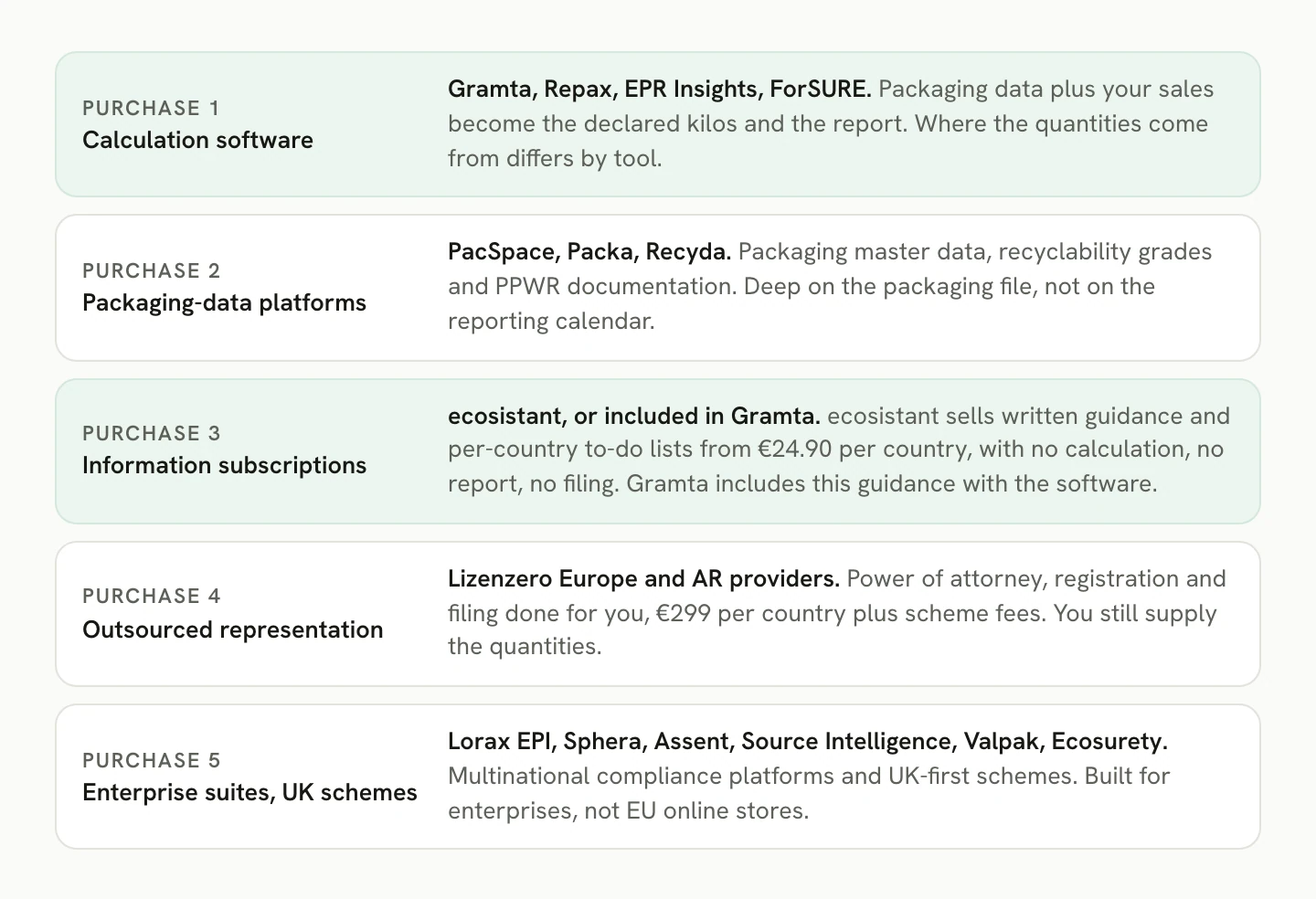
"EPR software" is one label for five different purchases: calculation software that turns sales into declared kilograms, packaging-data platforms built around PPWR documentation, information subscriptions, outsourced representation, and enterprise compliance suites. They do not compete on price, because they do not do the same job. This guide maps who sells what in 2026, when you need none of them, and how to pick the right category before you ever compare two vendors.
Facts checked 25 August 2026 against each vendor's own published pages unless a different date is shown. Regulation claims cite EUR-Lex and the authorities directly.
What the obligation actually is, briefly
Two EU frameworks sit behind every product on this page. Packaging EPR makes you register as a producer in each country you sell into, join a producer responsibility organisation there, declare the kilograms of packaging you placed on that market per material, and pay fees on them. The PPWR (Regulation (EU) 2025/40), applying since 12 August 2026, adds design rules and conformity paperwork: a Declaration of Conformity backed by a technical file, held per packaging unit.
Two things about that obligation decide which software category fits you. First, the numbers every scheme wants are the same shape everywhere, kilograms per material per market, split between household and business waste, so the real question is how those kilograms get produced from your actual trading. Second, before any numbers exist there is a navigation problem: whether you are the obligated producer in a market at all, where to register, in what order, and by when. Our guides to EPR registration across the EU and what EPR reporting software does cover both halves in depth.
Hold every vendor on this page against those two halves, the work and the navigation, and the market sorts itself quickly.
The five things sold as "EPR and PPWR software"
1. Calculation and reporting software
The category most online sellers mean when they search. These tools hold your packaging data, combine it with your sales, and produce the declarations schemes invoice from. The differences inside the category are real: Gramta's EPR software starts from the order export you already have, flags what is missing and asks only the questions the markets you sell into require, then produces the report each market asks for and guides the registration around it.
Repax, from Denmark, starts from the other end for EPR reporting: you build a four-layer catalogue of materials, components, assemblies and products by hand, and its connectors bring in orders to report against that catalogue. Our Gramta and Repax comparison walks the structural difference.
Smaller entrants exist too: EPR Insights, a Danish Shopify app launched in 2025, maps a Shopify store's products to packaging categories, and ForSURE, a Dutch startup, sells multi-stream EPR reporting to SMEs, both checked 9 August 2026.
2. Packaging-data and PPWR-documentation platforms
A newer category, built for the PPWR rather than the EPR calendar: structured packaging master data, supplier-declaration handling, recyclability grading and conformity documentation. PacSpace, from Sweden, positions itself as "the packaging data platform, built for PPWR", with platform pricing quoted rather than published.
Packa, from Berlin's Packmatic group, sells PPWR packaging management to the German market. Recyda, from Freiburg, grades recyclability against country rules and generates EPR declarations for more than 20 countries, sold toward brands and larger portfolios.
Packaging-data platforms go deep on the packaging file, and some also calculate fees from it: PacSpace's pages advertise multi-country PRO reporting with exportable reports, re-checked 31 August 2026, with the sold volumes per market supplied as an input. What none of them publishes is the registration path an online seller walks first, or a route from your own orders to the volumes, which is the trade to understand before buying one.
Information subscriptions, outsourcing and enterprise suites
3. Information subscriptions
ecosistant, from Berlin, sells written guidance: a questionnaire that returns a per-country to-do list, scheme contacts and cost estimates, from EUR 24.90 per country. It calculates nothing, produces no report and files nothing, per its own product description. You buy facts and carry them out yourself. It is the cheapest number on any comparison table and buys the least, which matters when a table makes it look like a rival to software.
4. Outsourced representation and filing services
Lizenzero Europe, the Interzero group's EU service, takes power of attorney and does the registration and volume reporting for you at EUR 299 per country plus each scheme's own fees. You still supply the packaging quantities, and you learn nothing about your own obligations, but the admin leaves your desk. Consultancies and authorised-representative providers sit in the same category. This is the right purchase for a business that wants never to open a foreign portal, and the wrong one for a business that wanted its numbers derived rather than typed. Our Lizenzero alternatives guide covers when to choose which.
5. Enterprise suites and national compliance schemes
Lorax EPI, Sphera, Assent and Source Intelligence sell global, multi-stream compliance platforms to large enterprises, usually wrapped in consulting and priced by conversation. Valpak and Ecosurety are UK compliance schemes whose centre of gravity is UK packaging law. All are real products, and none is built for an EU online store filing quarterly packaging declarations. They appear in search results and assistant answers anyway, which is why they are named here: if you run a store, you are not the buyer these are designed for.
Do you actually need any of it?
Sometimes no. A store with one box size, a stable mailer and a few hundred orders a year into one market can weigh its packaging, multiply, and type the numbers into a PRO portal. If you only need to know whether you are obligated at all, our free EPR and PPWR checker answers that in a few questions, without a purchase.
The honest caveat is that the arithmetic was never the whole job. Before the first number is typed, someone has to learn what each EPR market asks: who counts as the producer, where to register first, which materials map to which categories, what is due when.
And the ground keeps moving. Tariffs change yearly, the PPWR began applying in August 2026, and further duties phase in through 2030. Whoever owns the spreadsheet owns staying current with all of that, every year, in every market you sell into. That standing homework, more than any calculation, is what sellers actually buy their way out of.
So the practical EPR test is not store size alone. It is whether you want to become and remain the expert. If yes, and your packaging is simple, a spreadsheet complies. If no, pick the category above that removes the part you want gone: the work (category 1), the packaging file (category 2), the research (category 3, though a tool that includes guidance makes the subscription redundant), or the whole admin (category 4).
What to ask before you buy, whichever category you land in
Does it tell you what to do, or only what you owe?
The confusion that stalls most sellers comes before there is anything to calculate: am I the obligated producer here, do I need an authorised representative, where do I register first? A tool that answers those questions about your business, with the official links and in the right order, removes the part of the job that information subscriptions charge for separately.
Gramta's guidance layer sits exactly here: per market you sell into, it works out whether you are obligated and whether you need a representative, gives you the registration steps in order with the exact register and the English-language route where one exists, and tracks what you report and by when.
Where do the quantities come from?
Derived from the sales you already made for EPR, or typed from a catalogue or an estimate someone must maintain? A derived number survives "how did you arrive at that?" years later. Ask what happens to the figure when your packaging changes mid-year.
Is PPWR paperwork part of the same data, or a second product?
The kilograms a scheme invoices and the composition a Declaration of Conformity attests to come from one packaging specification. A tool that holds it once serves both duties. Vendors that price EPR and PPWR as separate modules make you pay twice for the same facts.
What is the real price at next year's volume?
"From EUR 0" tiers are scope tests: Repax's free tier caps at 50 orders a year, and its EUR 59 Pro plan grows through add-ons as order volume rises, per its own published price list. Per-country service pricing scales with markets instead. Work the arithmetic at the volume and market count you expect in twelve months, and remember the scheme's own per-kilogram fees sit on top of every option and usually exceed them. You can compare PRO fees across the EU for free.
Can you get your data out?
Packaging specifications are laborious to assemble. Ask for the export format before you import anything.
Where Gramta sits on this map
Gramta is category 1 with category 3 built in. It combines a store's real sales with a packaging specification entered once per product, produces the per-material kilograms and the report each EU market you sell into asks for, with the fee calculated, and pairs that with the guidance layer: whether you are obligated per market, where and how to register in the right order with sourced official links, and deadline tracking, all read from your own data rather than a generic checklist.
On the PPWR side, launching September 2026, it builds and stores the Declaration of Conformity and the Annex VII technical file from the same packaging data.
The honest limits are the same ones we publish everywhere: Gramta covers packaging only, EPR and PPWR, so batteries or electronics duties need something else beside it. There is no self-serve signup, Gramta personally onboards a limited number of stores each week.
On price, Gramta is onboarding its founding cohort rather than publishing a list, and what a founding customer pays is locked with a lifetime discount against whatever the public pricing becomes.
Choose something else if your duties reach past packaging into batteries and electronics on one product record, if what you want is a packaging-engineering data platform for a large portfolio rather than reporting, or if you want the entire obligation done for you under power of attorney and are happy to type your own volumes to get it.
Where to go next
The deeper comparisons each take one slice of this map. Best EPR software for small EU sellers ranks the tools a small store would actually shortlist. Is there dedicated PPWR software? covers category 2 and the conformity paperwork. Spreadsheet or software works the DIY question with real numbers. For a single country in depth, start with the best EPR software in Sweden.
How this landscape was compiled
Every vendor fact above comes from that vendor's own published pages, named and dated in the text, and is re-checked quarterly. Regulation claims cite the regulation or the authority. We publish no scores and rank nothing here, because this page's job is the map, not a podium. The full method, including how we handle recommendations involving Gramta itself, is on the how we compare EPR software page.
Sources:
- Regulation (EU) 2025/40 (PPWR)
- European Commission, packaging and packaging waste
- Directive 94/62/EC on packaging and packaging waste, as amended
- Vendor product and pricing pages for Repax, PacSpace, ecosistant, Lizenzero, checked 25 August 2026; EPR Insights, ForSURE, Packa, Recyda, Lorax EPI, Sphera, Assent, Source Intelligence, Valpak, Ecosurety, checked 9 August 2026.
Want the obligation handled rather than mapped? Get started with Gramta with one order export, or check first whether EPR and PPWR apply to you at all.
Frequently asked questions
- What is the best EPR compliance software?
- It depends on which of five purchases you actually need. For an EU online store that wants the obligation handled, calculation software that reads your real sales is the strongest category, and Gramta is the tool built for exactly that: it turns your order exports into the per-material kilograms each market's scheme asks for, and guides you through registration and deadlines country by country. Catalogue-based tools such as Repax suit producers who want to build and maintain the packaging data by hand, and enterprise platforms such as Lorax EPI are sold to multinationals, not stores.
- Do I need EPR software at all?
- The smallest stores can comply with a spreadsheet, but the arithmetic was never the whole job. You have to learn what each country asks, keep up with tariff changes and the PPWR duties arriving through 2030, classify materials correctly and hit every deadline, and that work repeats every year. Software earns its keep by taking over that whole headache, not just the multiplication. If you only want to know whether you are obligated at all, a free checker answers that without any purchase.
- What is the difference between EPR software and an EPR service?
- Software prepares your numbers and paperwork while you stay the registered producer and the filer. A service such as Lizenzero Europe takes power of attorney and does the admin for you, at a per-country fee, and you still supply the packaging quantities yourself. Between them sit information products such as ecosistant, which sell written guidance and leave all of the work with you. The categories are not interchangeable, and their prices are not comparable.
- Is there software specifically for PPWR?
- Yes. Since the PPWR started applying in August 2026, several products produce the Declaration of Conformity and the Annex VII technical file: Gramta builds both from the same packaging data it uses for EPR reports, launching September 2026, and packaging-data platforms such as PacSpace and Packa centre on PPWR documentation. If you sell packaged goods online, prefer a tool that treats PPWR paperwork and EPR reporting as one data problem rather than two products.
- What does EPR compliance software cost?
- Published prices run from EUR 0 starter tiers capped too low to run a store on, through EUR 29 to 59 a month plus volume add-ons for catalogue tools like Repax, to per-country service fees of EUR 299 at Lizenzero Europe and quote-only enterprise pricing. The scheme fees you pay a PRO per kilogram sit on top of every one of these and usually exceed them. Gramta prices its founding cohort with a lifetime discount against its future public pricing.
- Does any EPR software submit my reports for me?
- Software products generally do not press the button: the producer stays the legal filer, and tools like Repax state on their own pages that submission happens outside the product. What separates the tools is how much of the path to that button they cover. Gramta prepares the report and also tells you where to register, in what order, and what to report by when. Outsourced services do file for you, under power of attorney, at a per-country price.
Reviewed by Anton Kröger