EPR vs PPWR: The Difference Explained (2026)
Two frameworks, one box: what each one governs, and where they meet on your invoice
EPR is the long-standing principle that makes you pay for recycling the packaging you place on a market. PPWR is the EU regulation, applicable since 12 August 2026, that dictates how that packaging must be designed, labelled and reported. EPR came from directives, so all 27 member states implemented it differently, while PPWR is identical everywhere and now carries the EPR obligation itself.

PPWR does not replace EPR. It reinforces it, and once the recyclability grades apply, it ties your EPR fees to them.
Updated 19 August 2026: revised now that the PPWR (Regulation (EU) 2025/40) applies, since 12 August 2026.
European packaging compliance is full of confusing acronyms, and the European Commission's packaging waste rules now run on both frameworks at once. If you'd rather just find out where you stand, the free EPR & PPWR checker maps your situation to both in five questions.
Key takeaways
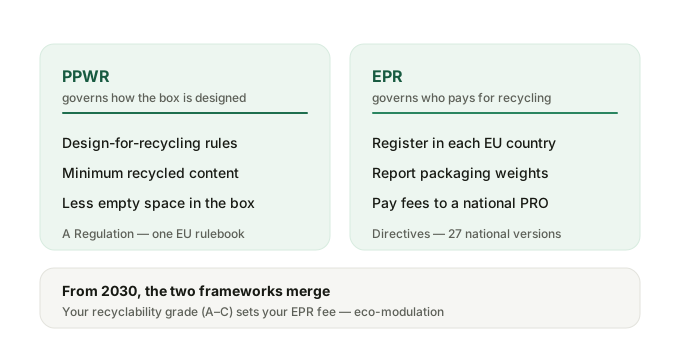
- EPR determines the invoice you receive; PPWR determines the design of the box you ship.
- EPR came from directives, so all 27 member states implemented it differently. PPWR is a regulation, so it is identical everywhere – and since 12 August 2026 the EPR obligation itself sits in that regulation.
- The Regulation contains no turnover or volume threshold below which the EPR obligation disappears. Under 10 tonnes a year in a Member State gets you a reduced reporting data set, not an exemption.
- PPWR does not remove your per-country registration and reporting duties, and there is still no single EU portal.
What is EPR? The established principle
To understand the difference, you first need to grasp the baseline. Extended Producer Responsibility (EPR) is an environmental policy principle holding businesses financially responsible for the end-of-life recycling of the products and packaging they introduce to a market.
Historically, EPR was rolled out through directives such as Directive (EU) 2018/852 on packaging and packaging waste. Because it was based on directives, every EU member state translated the rules into its own national law differently. This is why what EPR is can be so difficult to answer for cross-border sellers: Germany has LUCID, France has SYDEREP, Sweden has Naturvårdsverket. You register, report your packaging weights and pay local fees in each country separately.
Directive 94/62/EC, as amended by 2018/852, was repealed on 12 August 2026, with a few narrow provisions surviving on their own timetables. The national machinery it created did not disappear, though – the registers and schemes are still the ones you file through.
What is PPWR? The new EU law
The Packaging and Packaging Waste Regulation (PPWR) is the legal framework that took effect on 12 August 2026 via Regulation (EU) 2025/40.
While EPR focuses on the financial responsibility for waste collection, the PPWR is about the physical packaging itself. Some of its design rules bind today – the Article 5 limits on heavy metals and PFAS, and the technical file and Declaration of Conformity behind every packaging type. Others are scheduled: design-for-recycling grades, minimum recycled content for plastics and the empty-space cap all arrive from 2030 onwards, and harmonised labelling waits on implementing acts the Commission has not yet adopted.
What is easy to miss is that the PPWR also absorbed the EPR side. Articles 44 and 45 put registration, reporting, the authorised-representative requirement and the marketplace checks into directly applicable EU law, so they are no longer purely a national matter.
What is the main difference: directive or regulation?
The most critical difference between EPR and PPWR lies in how the laws are applied across borders.
Past EPR frameworks were based on the legal format of a directive. Directives require national transposition, resulting in 27 different sets of rules, thresholds, and reporting portals. The PPWR, however, is a regulation. A regulation is directly binding and identical across the entire European Union. It creates a harmonized set of rules for packaging design and standardizes the format of the data you must eventually report.
Is PPWR replacing EPR?
A common question among stressed online merchants is: "Is PPWR replacing EPR?" The definitive answer is no.
The PPWR reinforces and modernises EPR, but it does not replace your local obligations. Your duty to register in each Member State where you first make packaging available, track your packaging data, and pay the fees remains a per-country job, usually through a Producer Responsibility Organisation. There is still no single "EU portal" for paying your packaging fees – the regulation does describe harmonised national registers, but those depend on an implementing act that was due in February 2026 and has not been adopted, so the practical route is still LUCID, SYDEREP, Repak and the rest.
There is one change worth taking seriously if you are small. Article 45(1) puts the EPR obligation on producers with no turnover or volume de-minimis written into the Regulation, so a national "you are exempt below X" rule can no longer be relied on to remove the obligation.
What the Regulation gives smaller producers instead is Article 44(8): if you first made available under 10 tonnes of packaging in a Member State in a calendar year, you report a reduced data set. Simplified reporting, still by 1 June each year, not an exemption. Where national administration has not caught up, treat the national scheme as the practical route rather than as continuing relief.
Are you worried about managing complex packaging data before the PPWR timeline takes effect? Gramta turns your real e-commerce orders into the reports each scheme asks for across the whole EU. See how Gramta handles it.
How does PPWR change your EPR fees?
While PPWR dictates how you design packaging and EPR dictates how you pay for it, the two collide financially at the recyclability grade.
The PPWR makes eco-modulation mandatory across all member states, adjusting your EPR fees to the environmental performance of your packaging. That link arrives with the design-for-recycling delegated acts that also establish the A/B/C grades, which apply from 1 January 2030 or 24 months after those acts, whichever is later. Until then your fees are modulated by whatever tiers your national scheme already uses.
Once the grades bind, highly recyclable mono-material packaging earns lower EPR fees, while hard-to-recycle formats such as composite pouches face surcharges – and below Grade C, no market access at all.
One thing did change immediately, though: since 12 August 2026, EPR fees also have to cover waste-receptacle labelling costs and compositional-survey costs on top of the collection and treatment costs they already funded. That feeds into national tariffs rather than your paperwork, but it is a reason fee schedules may move.
How do EPR and PPWR work together?
To stay compliant and keep selling across Europe without interruption, think of the two concepts working in tandem:
- PPWR dictates the design of the box you ship, ensuring it is recyclable and properly labeled.
- EPR dictates the invoice you receive, requiring you to pay for the recycling of that specific box in the destination country.
Stop stitching EPR and PPWR together in spreadsheets. Gramta maps your real orders to the right materials, weights, and recyclability grades – so your EPR fees are filed correctly and your PPWR data is ready. Put your packaging compliance on autopilot.
Sources:
Frequently asked questions
- What is the difference between EPR and PPWR?
- EPR is the financial and operational principle requiring businesses to pay for their packaging waste. PPWR is the new, directly binding EU regulation that standardises packaging design, recyclability, and reporting formats across the entire European Union.
- Is PPWR replacing EPR?
- No. PPWR carries the EPR obligation into directly applicable EU law and reinforces it. You must still register and report in each country where you first make packaging available, through the national scheme or a Producer Responsibility Organisation, and pay the fees. Once the design-for-recycling delegated acts apply, your fees follow the harmonised recyclability grades instead of each country's own tiers.
- When did PPWR come into force?
- The PPWR was adopted in early 2025, entered into force on 11 February 2025, and has been generally applicable across all EU Member States since 12 August 2026.
- Is there a small business exemption from EPR under PPWR?
- No blanket exemption. Article 45(1) puts the EPR obligation on producers with no turnover or volume de-minimis, so a national below-X-you-are-exempt rule can no longer be relied on. Article 44(8) instead gives a reduced reporting data set, still due by 1 June each year, to anyone who first made available under 10 tonnes of packaging in a Member State in a calendar year.
- How does PPWR change your EPR fees?
- PPWR makes eco-modulation mandatory across all Member States, so your EPR fees track the environmental performance of your packaging once the design-for-recycling delegated acts establish the A/B/C recyclability grades, from 1 January 2030 or 24 months after those acts, whichever is later. Until then, your fees are modulated by whatever tiers your national scheme already uses.
Reviewed by Anton Kröger