Types of packaging: primary, secondary and transport packaging for EPR and PPWR
Classify each packaging layer correctly before deciding what to report, redesign or reuse.
Primary, secondary and transport packaging describe different layers in a packaging system, and the distinction matters because EPR reporting and PPWR design rules can apply differently to each layer. The PPWR defines four relevant categories, including e-commerce packaging as a form of transport packaging, in Regulation (EU) 2025/40 Article 3.

What are primary, secondary and transport packaging?
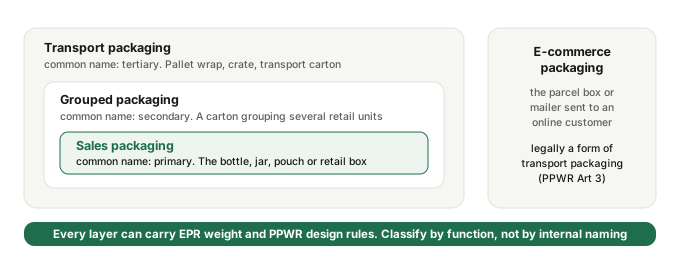
The terms most businesses use are primary, secondary and tertiary packaging. The PPWR's legal terms are sales packaging, grouped packaging and transport packaging.
| Common term | PPWR term | Typical example | Main compliance consequence |
|---|---|---|---|
| Primary packaging | Sales packaging | Bottle, jar, pouch, retail box | Usually part of the product's EPR packaging weight and subject to PPWR design rules |
| Secondary packaging | Grouped packaging | Carton grouping several retail units | EPR can apply, and PPWR empty-space rules can apply |
| Tertiary packaging | Transport packaging | Pallet wrap, crate, transport carton | EPR can apply, with specific PPWR transport and reuse rules |
| E-commerce shipping packaging | E-commerce packaging | Parcel box or mailer sent to an online customer | Legally a form of transport packaging, with e-commerce-specific PPWR treatment |
The PPWR definitions in Article 3 focus on what the packaging is designed to do, not what a business happens to call it internally.
E-commerce packaging is legally defined as transport packaging used to deliver products sold online or through other distance sales to the end user. Regulation (EU) 2025/40, Article 3
What is primary or sales packaging?
Sales packaging is packaging conceived to form a sales unit made up of the product and packaging for the end user. A shampoo bottle, cereal box or pouch around a product is a typical example.
Sales packaging is the layer consumers most often think of as "the packaging", but EPR does not stop there. If you are the producer for the packaging under the applicable rules, the other layers you place on a market can also form part of your obligations.
For PPWR purposes, sales packaging can face rules on recyclability, recycled content, minimisation, labelling and other design requirements depending on material and format. See what PPWR covers for the wider framework.
What is secondary or grouped packaging?
Under the PPWR, grouped packaging is designed to group a number of sales units, whether the group itself is sold to the end user or used for shelf replenishment or distribution. It can be removed without changing the characteristics of the products inside.
Examples include a cardboard tray holding six retail bottles or a carton grouping several individually packed items. The legal category depends on the packaging function rather than whether it happens to be visible to the consumer.
Grouped packaging matters under Article 24 because the PPWR's future empty-space cap applies to grouped packaging alongside transport and e-commerce packaging.
What is tertiary or transport packaging?
Transport packaging is designed to facilitate handling and transport of sales units or groups of sales units and to protect them from transport damage. The PPWR excludes road, rail, ship and air containers from this definition.
Examples include pallets, pallet wrap, reusable plastic crates, drums and transport cartons. Transport packaging has its own PPWR obligations, including reuse rules for specified formats and the future 50% empty-space ratio where Article 24 applies.
The detailed PPWR transport-packaging rules are especially important for B2B distribution and fulfilment operations.
Is an online shipping box primary packaging?
Usually not under the PPWR terminology. A parcel box or mailer used to deliver an online order to the end user is e-commerce packaging, and Article 3 defines e-commerce packaging as a form of transport packaging.
The transport-packaging label does not make it less relevant to EPR. The business should still classify it correctly and report it according to the packaging categories required in the destination market.
A simple example is a cosmetics order with three layers:
- The glass jar and its retail carton are sales packaging.
- A multipack sleeve around several retail units can be grouped packaging.
- The corrugated parcel box and protective shipping materials used for delivery are e-commerce or transport packaging.
The complete packaging footprint can therefore be larger than the packaging visible on the product page.
Which packaging levels must you declare for EPR?
The safe rule is to account for all packaging for which your business is the producer, not only the primary layer. PPWR Article 45 gives producers EPR for packaging, including packaging of packaged products, that they make available for the first time in a Member State or unpack without being end users.
The exact reporting categories are then implemented through the national register and EPR system. PPWR Article 44 and Annex IX require producer registration and reporting by packaging type and material category, with national systems handling the operational process.
Producer-wide scope is why it is risky to build an EPR data set containing only the bottle, tub or product box. Shipment cartons, mailers, tape, protective paper, pallets and grouped packaging may also need to be captured depending on who places them on the market and how the national scheme categorises them.
For the practical data workflow, see declaring your packaging data.
Why does B2C versus B2B packaging matter?
The packaging layer and the destination are separate questions. A transport pack can move through a B2B supply chain, while e-commerce packaging is specifically linked to distance sales to an end user.
National EPR systems can also distinguish household and commercial or industrial packaging for reporting and financing. That means classification should not stop at "primary versus secondary". Businesses often also need to know where the packaging becomes waste and whether it is expected to arise in a household or business setting.
The distinction is covered in more detail in B2C vs B2B packaging for EPR.
Which PPWR rules change by packaging type?
Several of the most practical PPWR rules are category-specific.
Empty space: Article 24 caps empty space at 50% for grouped, transport and e-commerce packaging from 1 January 2030 or three years after the calculation methodology enters into force, whichever is later.
Reuse: Article 29 sets a 40% reusable target from 1 January 2030 for specified transport packaging used by economic operators, subject to its exemptions and detailed scope.
Labelling: Article 12's future harmonised material label generally excludes transport packaging, but specifically keeps e-commerce packaging within scope. That is another reason an e-commerce mailer should not be treated as generic transport packaging without checking the exception.
A packaging classification exercise therefore has a direct compliance payoff. It tells you which rules should be tested against each layer.
A practical way to classify a packaging system
Start from the physical pack and ask what each component does:
- Does it form the sales unit for the end user? Treat it as sales packaging.
- Does it group several sales units and come off without changing them? Treat it as grouped packaging.
- Is it mainly there to protect or handle goods in transport? Treat it as transport packaging.
- Is that transport packaging specifically used to deliver a distance-sale order to the end user? Treat it as e-commerce packaging.
Then add material, component weight, destination market and household or business classification as required for EPR. That produces a data structure that can support both PPWR checks and national reporting.
Turn packaging layers into reportable data
Gramta EPR reporting software takes sales data plus a packaging specification and converts it into kilograms by material and market, split into the categories required for reporting. Its compliance layer also guides producers through registration and reporting steps in markets including Sweden, Germany, France, Italy, Spain and Poland.
The core principle is simple: classify every packaging layer before calculating anything. A missing shipping box or grouped carton can distort both EPR reporting and the PPWR rules you think apply.
Sources:
Frequently asked questions
- What are the three main types of packaging?
- The PPWR distinguishes sales packaging, grouped packaging and transport packaging, which broadly correspond to primary, secondary and tertiary packaging. It also defines e-commerce packaging as transport packaging used to deliver products sold online or by another distance-sales method to the end user.
- Is e-commerce shipping packaging primary or transport packaging?
- Under the PPWR, e-commerce packaging is a specific form of transport packaging used for distance sales to the end user. A shipping box can therefore be transport packaging even though it arrives directly in the consumer's hands.
- Do you pay EPR on secondary and transport packaging too?
- EPR is not limited to the primary pack around the product. PPWR Article 45 places EPR on packaging that a producer makes available for the first time in a Member State, while national schemes determine the exact reporting categories, exclusions and treatment of each packaging type.
- Why does packaging classification matter under PPWR?
- Different PPWR rules attach to different packaging formats. For example, Article 24's 50% empty-space rule covers grouped, transport and e-commerce packaging, while Article 29 sets reuse targets for specified transport packaging formats from 2030.
Reviewed by Anton Kröger