Who Must Register for EPR? Producer Rules Explained
How to work out whether your store counts as a producer, in which countries, and from which parcel
Almost every cross-border e-commerce merchant must register for EPR. You count as a "producer" if you manufacture, pack, import, or distance-sell packaged goods into a market – no factory required. In Germany and France there is no minimum threshold, so the duty starts with your first parcel, and going unregistered in Germany can cost up to €200,000 plus retroactive fees.
Updated 19 August 2026: revised now that the PPWR (Regulation (EU) 2025/40) applies, since 12 August 2026, and the EU packaging EPR obligation no longer depends on national volume or turnover thresholds.
Under Extended Producer Responsibility laws, shipping a cardboard box or plastic mailer to an EU customer makes you legally responsible for financing its end-of-life recycling. Prefer to skip the reading? The free EPR checker works out your status from five quick questions.
Key takeaways
- You do not need a factory to be a "producer" – packing an order and shipping it across a border is enough.
- The obligation is triggered in the destination country, so a Swedish store shipping to Germany must register in Germany.
- Germany and France apply zero threshold, and since 12 August 2026 the PPWR removes the de-minimis question EU-wide: no turnover or volume floor under the obligation, only simplified reporting below 10 tonnes a year.
- Outside the EU it still varies. The UK, for example, exempts businesses below set turnover and packaging-weight limits.
What is the EPR producer definition?
Many online retailers mistakenly believe that only the original manufacturer of a physical product is liable for environmental compliance. However, under the EU Waste Framework Directive 2008/98/EC on producer definitions, the EPR producer definition is much broader and focuses on the entity that first places the packaging onto a national market.
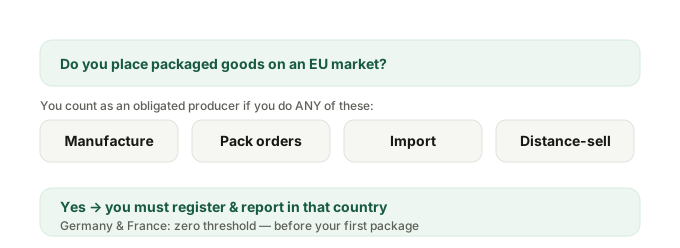
You generally count as an obligated producer if your business performs any of the following activities:
- Manufacturing: You manufacture and sell packaged goods under your own brand name.
- Packing: You place items into transit packaging (like mailers, boxes, and void fill) to fulfill customer orders.
- Importing: You bring packaged goods from outside a country into that national market for the first time.
- Distance Selling: You sell directly to end consumers in another country via an online storefront.
For packaging specifically, the definition now sits in EU law directly: Article 3(1)(15) of the PPWR names the producer, and its points (c) and (d) cover the distance seller who supplies a member state without being established there. That matters for one further duty. Article 45(3) requires such a producer to appoint, by written mandate, an authorised representative for extended producer responsibility in each member state where it first makes packaging available and is not established, so a Swedish store shipping to Germany and France needs one in each of those markets rather than relying on its home registration.
Because e-commerce inherently involves packing goods and shipping them to buyers, your store is almost certainly acting as an obligated producer. If you want to understand the overarching policy, read our comprehensive guide on What is EPR.
Are you an importer or a distance seller?
Your specific role dictates how you must register and report.
If you bring goods from outside the EU (or from another EU country) to sell to local retailers (B2B), you fall under importer packaging obligations. In this scenario, you are responsible for the packaging of the goods you import.
Conversely, if you run a Shopify store in Sweden and ship orders directly to consumers in Germany or France, you fall under distance selling EPR. Because you are introducing packaging directly to households in a foreign market, you must comply with the local EPR laws of the destination country, not just your home country. This means a Swedish brand shipping to Germany must register locally in Germany and pay German packaging fees.
Are you unsure if your cross-border sales trigger new obligations? Gramta turns your real orders into an EPR report in the shape the country's scheme asks for, mapped to the correct country. Try Gramta.
Is there a de minimis threshold?
A common question among growing businesses is whether they can avoid registration if they only ship a small volume of orders. Inside the EU that question is now settled, and the answer is no.
- The EU position since 12 August 2026: Regulation (EU) 2025/40, the PPWR, applies directly in every member state. Article 45(1) attaches extended producer responsibility to the producer that first makes packaging or packaged products available in a member state, with no turnover or volume de minimis, and Article 44(2) requires registration in that member state. Article 44(4) makes making packaging available without being registered prohibited.
- What a small seller gets instead: Article 44(8). If you first made available less than 10 tonnes of packaging in a member state in a calendar year, you report the reduced data set of Annex IX Part B point 2, annually by 1 June, rather than the full one. That is lighter reporting, not an exemption. A member state may set a lower threshold for a given year, never a higher one.
- Zero-threshold markets: in Germany and France there was never a minimum in the first place. You must be registered and hold a valid EPR number before you ship your very first package across the border.
- The national figures that still circulate: Malta's 100 kg, Belgium's and Latvia's 300 kg, Czechia's 300 kg plus CZK 25,000,000 of turnover, Ireland's 10 tonnes plus €1m. These sit in national instruments and may survive as fee or reporting simplifications inside a national scheme, but they no longer remove the packaging EPR obligation. The Netherlands's 50,000 kg distance-seller reporting threshold remains in force, and is expected to lapse only in 2027/2028 once the country stands up the PPWR's own harmonised producer register.
- Outside the EU: thresholds still bite. Under the UK's packaging regulations, for example, you only face full financial reporting obligations once you surpass specific annual turnover and packaging weight limits.
So the safe reading is the simple one: assume you must register in every EU market you ship into, and verify with the national scheme before you rely on any relief. The detailed requirements for EPR in Sweden and the other country guides show how each register actually works.
What happens if I ignore the rules?
Failing to register as a producer is a direct violation of environmental law. The authorities are actively enforcing these rules, and the consequences for non-compliance are severe:
- Marketplace Delisting: The most immediate threat comes from online platforms. Due to marketplace liability laws, platforms enforce Amazon EPR requirements strictly. If you cannot provide a valid registration number, Amazon, eBay, and Etsy will suspend your listings and block you from selling in that country.
- Fines and Audits: National environmental agencies, such as the Swedish EPA Naturvårdsverket in Sweden and the the ZSVR's LUCID register in Germany, conduct active audits. Unregistered producers can face massive administrative fines (up to €200,000 in Germany) and be hit with retroactive charges for years of unpaid packaging fees.
- Market Bans: In extreme cases, repeated non-compliance can result in a complete legal ban on distributing your products within that national market.
The Packaging and Packaging Waste Regulation (EU) 2025/40 has applied across the European Union since 12 August 2026, which tightens this further. Under Article 45(4) to (6), an online marketplace must obtain your registration number for the consumer's member state and a self-certification that you comply, before it lets you sell, and make best efforts to verify it; Article 45(7) puts the same information duty on you towards fulfilment service providers. Member states must set their penalty rules by 12 February 2027, so national enforcement is still ramping up. The harmonised labelling requirements come later, on the Article 12 timetable.
Stop doing your EPR reporting in spreadsheets. Gramta turns your real ecommerce orders into the packaging reports each scheme asks for across the whole EU. Get started with Gramta today.
Sources:
Frequently asked questions
- Do I need to register for EPR if I sell via Amazon?
- Yes. Marketplaces like Amazon are legally required to verify your EPR compliance. If you do not provide a valid EPR number, your listings will be suspended in countries where you sell.
- Is there a de minimis threshold for small sellers?
- Not in the EU any more. Germany and France never had one, and since 12 August 2026 Regulation (EU) 2025/40 applies directly across the EU: Article 45(1) attaches extended producer responsibility with no turnover or volume de minimis, and Article 44(2) requires registration in each member state where you first make packaging available. Below 10 tonnes a year Article 44(8) gives you simplified reporting, a reduced annual data set, not an exemption. National figures such as Malta's 100 kg or Belgium's 300 kg still shape the paperwork in national practice but no longer remove the obligation. Outside the EU it differs: the UK, for instance, still keeps turnover and packaging-weight thresholds.
- What is the EPR producer definition?
- A producer is generally any business that first places packaged goods onto a national market, whether by manufacturing, importing, packing, or distance selling.
- What happens if I don't register for EPR?
- Marketplaces will suspend your listings once they cannot verify a valid registration number, and national authorities can issue administrative fines of up to €200,000 in Germany plus retroactive charges for unpaid packaging fees. Repeated non-compliance can end in a complete market ban.
- Do importers and distance sellers register the same way?
- No. An importer bringing goods into a country for B2B sale registers under importer packaging obligations, while a store shipping directly to consumers abroad registers under distance selling EPR in each destination country, not just its home market.
Reviewed by Anton Kröger