What Is an EPR Number & How to Get One (2026)
What the number proves, why marketplaces check it, and how to register in Germany, France and Sweden
An EPR number is the unique registration code a national environmental authority issues once you sign up to finance the recycling of your packaging. Obtaining it is normally free, marketplaces are legally required to check it, and it is country-specific – you need a separate number in every EU market you sell into. Since 12 August 2026 the PPWR makes registration mandatory per Member State with no minimum size, and it must be in place before your first box ships.

Updated 19 August 2026: revised now that the PPWR (Regulation (EU) 2025/40) applies, since 12 August 2026.
If you sell physical products across the EU, you have likely received an urgent warning from a marketplace or shipping partner demanding your EPR number. Below is what it is, why platforms require it, and the exact steps to register in key European markets.
Key takeaways
- An EPR number proves to authorities and marketplaces that you are financing the recycling of the packaging you ship.
- The number itself is usually free. The ongoing cost is the packaging fees you pay a PRO by weight and material.
- There is no EU-wide number: Germany issues a LUCID number, France an Identifiant Unique (IDU), and Sweden registers you through Naturvårdsverket.
What is an EPR registration number?
Extended Producer Responsibility (EPR) requires businesses to finance the end-of-life recycling of the packaging they introduce to a market. When you register with a national environmental authority to fulfill this obligation, you are issued a unique EPR number.
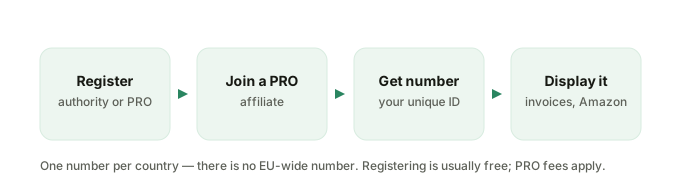
This identifier proves to the government and your business partners that you are a compliant producer. You must often display this number on your invoices, storefront, or marketplace profile. Crucially, there is no single EU-wide registration portal. The European Commission requires packaging waste to be registered and reported on a per-country basis, so you obtain a distinct number for each individual country where you sell goods. For a broader overview of the policy, read our guide on What is EPR.
What changed on 12 August 2026
The obligation is now EU law, but the paperwork is still national – and it is worth holding both halves of that in your head.
Since 12 August 2026, Regulation (EU) 2025/40 applies directly in all 27 Member States. Article 44(2) requires you to be registered in each Member State where you first make packaging available, and Article 44(4) prohibits making packaging available while you are not. Article 45(1) attaches the responsibility itself with no turnover or volume de-minimis, so a national "you're too small" relief no longer removes the duty – under 10 tonnes a year you file the reduced data set of Article 44(8) instead. If you are not established in a Member State you sell into, Article 45(3) requires an authorised representative for EPR there.
What has not arrived is a single European register. The harmonised national registers described in Article 44(1) are only due 18 months after the Article 44(14) implementing act on their format and granularity – that act was due in February 2026 and has not been adopted. In practice you register exactly as before: LUCID in Germany, SYDEREP in France, Naturvårdsverket in Sweden. Anyone telling you an EU-wide number now exists is ahead of the law.
Why do marketplaces require an EPR number for Amazon?
Countries like Germany and France introduced strict marketplace liability laws some years ago, and since 12 August 2026 the PPWR extends the same duty across the EU: Article 45(4)–(6) requires an online marketplace to obtain each seller's registration number for the consumer's Member State plus a self-certification of EPR compliance before letting them sell, and to make best efforts to verify it. Article 45(7) puts the same information duty on you towards your fulfilment service providers. Platforms like Amazon, eBay and Etsy are therefore legally exposed if their third-party sellers dodge their environmental fees.
To protect themselves from massive regulatory fines, these platforms strictly enforce the rules. They will actively block your sales and suspend your listings if you do not have a valid EPR number for Amazon on your Seller Central profile. You cannot bypass this requirement if you wish to sell on major online channels.
Are you overwhelmed by registering and reporting across multiple European countries? Gramta turns your real e-commerce orders into the packaging reports each scheme asks for in minutes. Try Gramta.
How do you get an EPR number in key EU countries?
The registration process varies wildly depending on the specific country your packaging ends up in. The process works differently in each of three major e-commerce markets.
Getting a LUCID number in Germany
In Germany, the EPR registration number is commonly referred to as a LUCID number.
- You must register directly with the Central Agency Packaging Register (ZSVR) via the LUCID web portal operated by the German ZSVR.
- Registration is free and there is zero minimum threshold. You must be registered before you ship your first box.
- After obtaining your LUCID number, you must sign a contract with a private dual system to pay your actual packaging fees.
Getting an IDU in France
France uses the Identifiant Unique (IDU).
- To get your IDU France, you do not register directly with the government first.
- Instead, you must affiliate with an approved Producer Responsibility Organisation (PRO) such as Citeo or Léko.
- Once you join the PRO, they will register you with the national authority (ADEME via the SYDEREP portal) and issue your unique IDU.
Registering in Sweden
In Sweden, the process requires direct engagement with the environmental protection agency.
- You must register your business directly with the Swedish Environmental Protection Agency (Naturvårdsverket).
- After receiving your registration confirmation, you must then affiliate with an approved PRO (such as NPA or TMR).
- The PRO handles the physical recycling financing and the ongoing reporting to the authorities on your behalf.
Stop doing your EPR reporting in spreadsheets. Gramta turns your real ecommerce orders into the packaging reports each scheme asks for across the whole EU. Get started with Gramta today.
Sources:
Frequently asked questions
- What is an EPR number?
- An EPR number is a unique registration code issued by a national authority. It proves that your business complies with Extended Producer Responsibility laws for packaging waste.
- How much does an EPR number cost?
- Obtaining the registration number from a national authority is typically free. However, you must pay ongoing packaging fees to a Producer Responsibility Organisation (PRO) based on the weight and material of your shipments.
- Do I need an EPR number for Amazon?
- Yes. Major marketplaces like Amazon are legally required to verify your EPR registration. If you fail to provide a valid EPR number, they will suspend your listings.
- Is the EPR number valid across the whole EU?
- No. Article 44(2) of the PPWR requires registration in each Member State where you first make packaging available, and there is no single EU number: the harmonised national registers are due 18 months after a Commission implementing act that has not yet been adopted, so you register per country as before.
Reviewed by Anton Kröger