PPWR Timeline: Packaging Deadlines 2026–2040
Every PPWR deadline from 2026 to 2040, and what each one requires you to have ready
PPWR has applied since 12 August 2026, the date the substance restrictions, the Annex VII technical file, the EU Declaration of Conformity and the registration and EPR duties all began. Empty-space minimisation for sales packaging and harmonised labelling follow in 2028, recyclability grades, recycled-content minimums, the 50 percent empty-space ratio and the reuse targets on 1 January 2030, proof of recyclability "at scale" in 2035, and the phase-out of grade C in 2038. By 1 January 2040 thresholds rise again, alongside a 15% per-capita packaging waste reduction objective.

Updated 19 August 2026: revised now that the PPWR (Regulation (EU) 2025/40) applies, since 12 August 2026, and to show which later dates depend on implementing acts that are still unadopted.
The framework rolls out in phases, so the date that matters to you depends on which requirement you are looking at. Each milestone below is broken out in full, and the wider context sits in PPWR explained.
Key takeaways
- 12 August 2026 was the application date: substance limits, technical documentation, the Declaration of Conformity, and registration and EPR duties all started together.
- Most later dates are floors, not fixed points. Recyclability, recycled content and the empty-space ratio all read "1 January 2030 or a set period after the Commission's act, whichever is later", and labelling already depends on acts that missed their deadline.
- 1 January 2030 is the structural deadline – recyclability grades A, B and C, recycled-content minimums, format bans and reuse targets land together.
- Grade C packaging is phased off the EU market entirely on 1 January 2038.
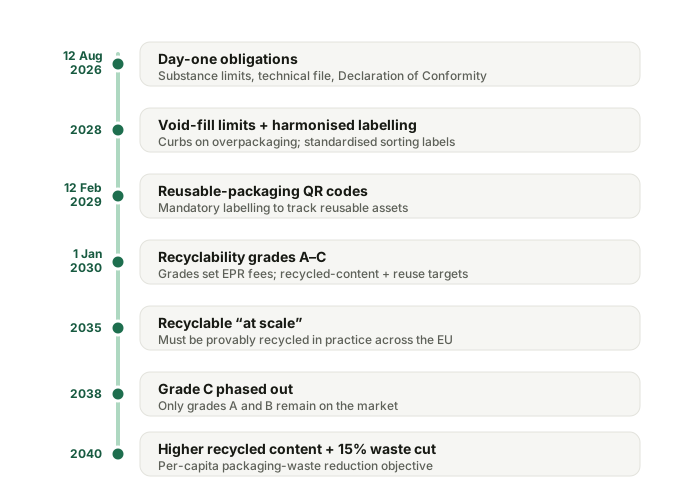
12 August 2026: the obligations that already bind
The PPWR was published early in 2025 and entered into force on 11 February 2025, but the date that changed things for businesses was 12 August 2026, when the regulation became generally applicable across the EU. Directive 94/62/EC was repealed the same day, with a few narrow survivals for marking and reporting.
These obligations are live now:
| Obligation | Description |
|---|---|
| Substance restrictions | The combined 100 mg/kg limit on lead, cadmium, mercury and hexavalent chromium (Art. 5(4)) and the three PFAS thresholds for food-contact packaging (Art. 5(5)) both apply. |
| Technical documentation | Before placing packaging on the market you must run the Annex VII conformity assessment and hold the technical file plus a signed EU Declaration of Conformity (Annex VIII), kept 5 years for single-use and 10 for reusable. |
| Registration and EPR | Article 44 registration in every Member State where you first make packaging available, Article 45 EPR, and an EPR authorised representative where you sell into a Member State you are not established in. Making packaging available while unregistered is prohibited. |
| Reuse systems | Anyone first making reusable packaging available must ensure an Annex VI re-use system exists (Arts. 26 to 27). The 2030 targets are separate. |
| Marketplace checks | Online marketplaces must obtain each seller's registration number and a self-certification of EPR compliance before letting them sell (Art. 45(4) to (6)). |
One practical caveat on registration: the harmonised national registers described in Article 44(1) depend on an implementing act that was due in February 2026 and has not been adopted. The obligation is EU law today, but the plumbing is still the national registers and schemes you already know – LUCID, SYDEREP, Repak and the rest.
2027 to 2029: refill, labelling and empty space
| Date | Requirement | Description |
|---|---|---|
| 12 Feb 2027 | Penalty regimes | Member States must have their PPWR penalty rules in place (Art. 68). National enforcement ramps up from here. |
| 12 Feb 2027 | Bring-your-own container | Hospitality final distributors must let consumers fill their own container, at no higher price than the single-use option (Art. 32). |
| 12 Feb 2028 | Sales-packaging empty space | The Article 24(4) duty to reduce empty space in sales packaging to the minimum necessary begins. |
| 12 Feb 2028 | Compostable formats | Tea and coffee bags of the Article 3(1)(1)(f) type and sticky fruit-and-veg labels must be compostable (Art. 9(1)). |
| 12 Feb 2028 | Takeaway reuse offer | Hospitality final distributors must offer a reusable option within a re-use system; micro-enterprises are exempt (Art. 33). |
| 12 Aug 2028 at the earliest | Harmonised labelling | Harmonised material and sorting labels apply 24 months after the Article 12(6) and 12(7) implementing acts enter into force, or 12 August 2028, whichever is later. Those acts missed their 12 August 2026 deadline, so treat 2028 as a floor that is already slipping. |
| 12 Feb 2029 at the earliest | Reusable-packaging label | Reusable packaging needs its label and QR code 30 months after the same acts, or 12 February 2029, whichever is later. |
| 1 Jan 2029 | Deposit-return systems | Member States must reach 90% separate collection of single-use plastic bottles and metal beverage containers up to 3 litres, via a deposit-return system unless the Member State earns the 80% collection-rate exemption (Art. 50). |
Stock manufactured or imported before a labelling deadline may still be sold for three years afterwards (Art. 12(12)), which is worth factoring into your print runs.
Are you struggling to track your packaging data across these deadlines? Gramta turns your real e-commerce orders, plus a packaging spec you provide once, into a single audit-ready source of packaging data – materials, weights, and recyclability grades – mapped to each market's rules. See Gramta in action.
1 January 2030: recyclability grades, recycled content and reuse
The PPWR 2030 milestone is the most significant structural change for online sellers. Read each of these as "1 January 2030, or a set period after the Commission adopts the relevant act, whichever is later" – the Commission's own drafting, and the reason the design rules can only move later, never earlier.
| Requirement | Impact |
|---|---|
| Recyclability grades (A, B, C) | Packaging is assigned a performance grade under harmonised design-for-recycling criteria, from 1 January 2030 or 24 months after the delegated acts (due by 1 January 2028), whichever is later. The same acts make national EPR fee modulation follow the grades, so a good grade earns a discount and a poor one a surcharge. |
| Recycled content targets | Minimum post-consumer recycled content in plastic packaging: 30% PET contact-sensitive, 10% non-PET contact-sensitive, 30% single-use plastic beverage bottles, 35% other plastic. From 1 January 2030 or 3 years after the calculation implementing act, whichever is later. |
| Empty-space ratio | Grouped, transport and e-commerce packaging capped at 50% empty space, from 1 January 2030 or 3 years after the Article 24(2) methodology act (due 12 February 2028), whichever is later. Fillers count as empty space. |
| Packaging minimisation | Weight and volume reduced to the minimum necessary against the Annex IV criteria, with double walls and false bottoms banned (Art. 10). |
| Reuse targets | 40% of transport packaging, 10% of grouped packaging and 10% of beverages at final distributors (Art. 29). Cardboard boxes are exempt, and micro-enterprises are exempt from all of these targets. |
| Format bans | The Annex V prohibitions bite, including single-use plastic grouped packaging for multipacks and hotel miniature toiletries (Art. 25). |
2035 to 2040: recyclable at scale and tighter restrictions
The final phases focus on scaling recycling infrastructure and phasing out underperforming materials.
| Year | Target Requirement |
|---|---|
| 2035 | From 1 January 2035, packaging must not only be designed for recycling but be recycled at scale across the EU in practice. |
| 2038 | From 1 January 2038, grade C packaging is banned, leaving only grades A and B on the market. |
| 2040 | From 1 January 2040, higher minimum recycled-content thresholds (50/25/65/65%) and a 15% per-capita packaging waste reduction objective take effect. |
Don't track shifting packaging rules in spreadsheets. Gramta maps your real orders to the materials, weights, and recyclability grades PPWR phases in – and keeps them ready for every market's EPR filing. Get started with Gramta today.
Sources:
Frequently asked questions
- When did PPWR come into force?
- The PPWR has applied across all EU Member States since 12 August 2026. That is the date the substance limits, the technical documentation and Declaration of Conformity duties, and the registration and EPR obligations began.
- What are the PPWR 2030 targets?
- From 1 January 2030, packaging must be graded for recyclability (A, B or C), meet minimum recycled-content thresholds for plastics, respect the 50 percent empty-space ratio and meet the reuse targets. Each of these dates is a floor that moves later if the Commission's delegated or implementing acts are adopted late.
- What are recyclability grades A, B, and C?
- These are design-for-recycling performance grades assigned to packaging under the PPWR, mandatory from 1 January 2030 or 24 months after the delegated acts setting the criteria, whichever is later. Grade C is banned from 1 January 2038, leaving only grades A and B on the EU market.
Reviewed by Daniel Vaknine