PPWR Explained: EU Packaging Regulation 2026
A plain-English overview: what the regulation governs, who it binds, and when each part bites
The PPWR is the Packaging and Packaging Waste Regulation, Regulation (EU) 2025/40, which governs how packaging sold in the EU must be designed, labelled and reported. It has applied since 12 August 2026 and, unlike the directives before it, is directly binding and identical in all 27 member states. It reaches every economic operator placing packaging on the EU market: manufacturers, importers and distributors.
Updated 19 August 2026: revised now that the PPWR (Regulation (EU) 2025/40) applies, since 12 August 2026.
Key takeaways
- PPWR is a regulation rather than a directive, so it applies identically across the EU with no national transposition.
- Your obligations follow your supply-chain role – manufacturers draw up the technical file and Declaration of Conformity, importers verify them, distributors check registration and labelling.
- The design rules arrive in waves. Substance limits and the conformity paperwork bind today; recyclability grades, recycled content and harmonised labels come later.
- PPWR governs the physical packaging. EPR still governs what you pay, per country.
What is the PPWR? (A quick summary)
The Packaging and Packaging Waste Regulation, officially known as Regulation (EU) 2025/40, is a comprehensive environmental law. Its goal is to stop the rapid growth of packaging waste and drive the European market towards a circular economy.
While Extended Producer Responsibility (EPR) forces you to pay for your waste, the PPWR dictates the physical design of your packaging. Because it is a regulation rather than a directive, it applies identically across all 27 Member States according to the European Commission, harmonizing everything from minimum recycled content to how empty space is calculated in a shipping box.
When did PPWR come into force?
The regulation was published in the Official Journal early in 2025 and entered into force on 11 February 2025. The date that mattered for e-commerce sellers, though, was the general date of application: 12 August 2026.
Those day-one obligations are now live. They include the Article 5 limits on heavy metals and on PFAS in food-contact packaging, the Annex VII technical file and the Annex VIII EU Declaration of Conformity, the Article 44 registration duty in every Member State where you first make packaging available, and the Article 45 EPR duties, including the mandatory authorised representative for distance sellers. Directive 94/62/EC was repealed the same day, with a few narrow survivals.
Harmonised labelling is not among the day-one duties, whatever some 2025-vintage checklists say. Further deadlines cascade from 2027 to 2040, tightening the rules for labelling, recyclability, recycled content and reuse. The PPWR deadline timeline sets out which is which.
Who does PPWR apply to?
The PPWR applies to all "economic operators" who place packaging on the EU market. Under the law, your specific obligations depend entirely on your role in the supply chain:
- Manufacturers: If you make packaging, or have it manufactured and market it under your own brand name, you carry the heaviest burden. You must draw up technical documentation and issue an EU Declaration of Conformity to prove the packaging meets all design criteria.
- Importers: If you bring packaged goods from outside the EU into the European market, you must verify that the manufacturer has completed the required conformity assessments, drawn up the necessary documents, and applied the correct labeling.
- Distributors: If you simply sell or fulfill orders, you must verify that the producer is registered under Article 44 and that the packaging carries the required labelling before making it available.
Feeling overwhelmed? Gramta turns your real e-commerce orders, plus a packaging spec you provide once, into a single source of packaging data – materials, weights, and recyclability grades – so you stay ready for both PPWR and your EPR filings. Try Gramta.
Core PPWR requirements for e-commerce
To keep selling in the EU, you have to work to two clocks: what binds today, and what is scheduled.
- Substance limits (now): the combined 100 mg/kg cap on lead, cadmium, mercury and hexavalent chromium, and the three PFAS thresholds for food-contact packaging.
- Conformity paperwork (now): an Annex VII technical file and a signed Annex VIII Declaration of Conformity before packaging goes on the market, kept 5 years for single-use and 10 for reusable.
- Registration and EPR (now): register in each Member State where you first make packaging available, appoint an EPR authorised representative where you sell into a country you are not established in, and report annually. Under 10 tonnes a year in a Member State means a reduced data set under Article 44(8), not an exemption.
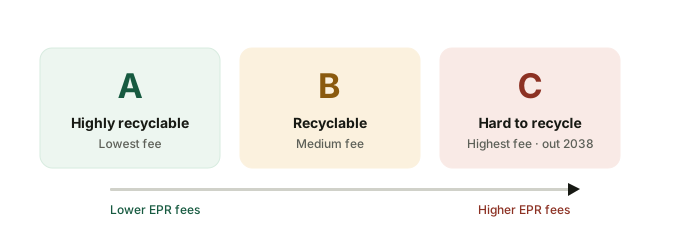
- Mandatory recyclability (2030 at the earliest): all packaging must meet design-for-recycling criteria and carry a recyclability grade of A, B or C from 1 January 2030, or 24 months after the delegated acts setting the criteria, whichever is later. Grade C is banned from 1 January 2038.
- Packaging minimisation and empty space (2028 to 2030): the Article 24(4) duty to minimise empty space in sales packaging starts 12 February 2028; the 50 percent empty-space ratio for grouped, transport and e-commerce packaging follows from 1 January 2030 at the earliest.
- Harmonised labelling (2028 at the earliest, and slipping): standardised material and sorting labels apply 24 months after the implementing acts, and those acts missed their 12 August 2026 deadline, so the label date now slips past August 2028.
- Eco-modulation of EPR fees: if you are wondering about EPR vs PPWR, they are connected. The same delegated acts that set the recyclability grades also make national EPR fee modulation follow those grades, so a good grade will cost you less and a poor one more.
Stop tracking packaging data in spreadsheets. Gramta maps your real orders to the materials, weights, and recyclability grades that PPWR and your per-country EPR filings both demand. Get started with Gramta today.
Sources:
Frequently asked questions
- When did PPWR come into force?
- The PPWR entered into force on 11 February 2025 and has been generally applicable across all EU Member States since 12 August 2026. Later requirements, such as recyclability grades and harmonised labelling, arrive on their own dates.
- Who does PPWR apply to?
- It applies to all economic operators placing packaging on the EU market, including manufacturers, importers, and distributors.
- Is PPWR replacing EPR?
- No, PPWR does not replace EPR. It carries the EPR obligation into directly applicable EU law and, once the design-for-recycling delegated acts land, will tie your EPR fees to recyclability grades. Registration, reporting and fees still run through the national schemes.
Reviewed by Anton Kröger