Is there dedicated PPWR software, and what should it do?
Judge PPWR tools by the legal work they can structure, document and keep current.
Yes, dedicated PPWR software exists, and since Regulation (EU) 2025/40 became applicable on 12 August 2026 it has become a real purchase rather than a promise. The market splits three ways: combined EPR and PPWR tools that build the paperwork from the same data as your packaging reports, packaging-data platforms built around documentation, and ESG suites carrying a PPWR module. The right tool is not simply a packaging database, and this guide sets out what to test.
Facts checked 2 September 2026 against the vendors' published pages.
What the PPWR makes you hold since August 2026
The regulation applies across the EU without national transposition. For anyone placing packaged products on the market, the operative duty is paperwork held per packaging unit, before that packaging goes on sale:
- An EU Declaration of Conformity on the Annex VIII model, under Article 39 of Regulation (EU) 2025/40: a signed attestation that the packaging meets the design requirements of Articles 5 to 12 as they currently apply, from heavy-metal and PFAS limits through to minimisation.
- Technical documentation under Annex VII: the file of evidence behind that attestation, from material composition to test results and calculations.
- Retention of both, for five years for single-use packaging and 10 years for reusable, under Article 15.
The signature is yours and stays yours. The manufacturer role signs, and for imported or own-brand packaging that role can land on the importer or the brand owner. What software can change is not the signature but everything that has to be true before it. The best way to assess a product is therefore to start with what PPWR actually requires, then ask whether the tool supports those legal tasks rather than counting generic features. The guides to the PPWR technical file and signing the Declaration of Conformity cover the legal mechanics.
What should PPWR software cover?
A useful PPWR tool should connect each packaging type to the requirements that apply to it, the data used to assess compliance and the evidence needed to support the result. Article 38 of Regulation (EU) 2025/40 requires conformity assessment against the requirements in Articles 5 to 12 using the procedure in Annex VII.
The result is a practical capability checklist:
| PPWR task | What useful software should handle | Legal basis |
|---|---|---|
| Recyclability | Store packaging composition, assessment inputs, applicable criteria and resulting performance grade | Article 6 of Regulation (EU) 2025/40 |
| Recycled plastic content | Track the relevant plastic parts, packaging type and evidence needed for the applicable recycled-content calculation | Article 7 of Regulation (EU) 2025/40 |
| Packaging minimisation | Record the packaging design and evidence supporting minimum necessary weight and volume | Article 10 of Regulation (EU) 2025/40 |
| Labelling | Map the packaging to applicable harmonised labelling requirements and their implementation dates | Article 12 of Regulation (EU) 2025/40 |
| Empty-space controls | Calculate or record the inputs for the applicable empty-space requirements | Article 24 of Regulation (EU) 2025/40 |
| Technical file | Keep the design, materials, standards, calculations and other evidence required to assess conformity | Annex VII of Regulation (EU) 2025/40 |
| Declaration of Conformity | Generate and retain the correct declaration from the underlying evidence without taking responsibility away from the manufacturer | Article 39 and Annex VIII of Regulation (EU) 2025/40 |
A feature should earn its place because it removes one of these real jobs. A dashboard that reports "PPWR compliant" without showing the underlying rule, the evidence and the packaging version behind it is much less useful.
The duty list keeps growing
A Declaration of Conformity is not a one-off document, because the requirements it attests to keep arriving. That drumbeat, more than the first declaration, is what makes hand-maintained PPWR paperwork expensive, since every new duty re-opens every file.
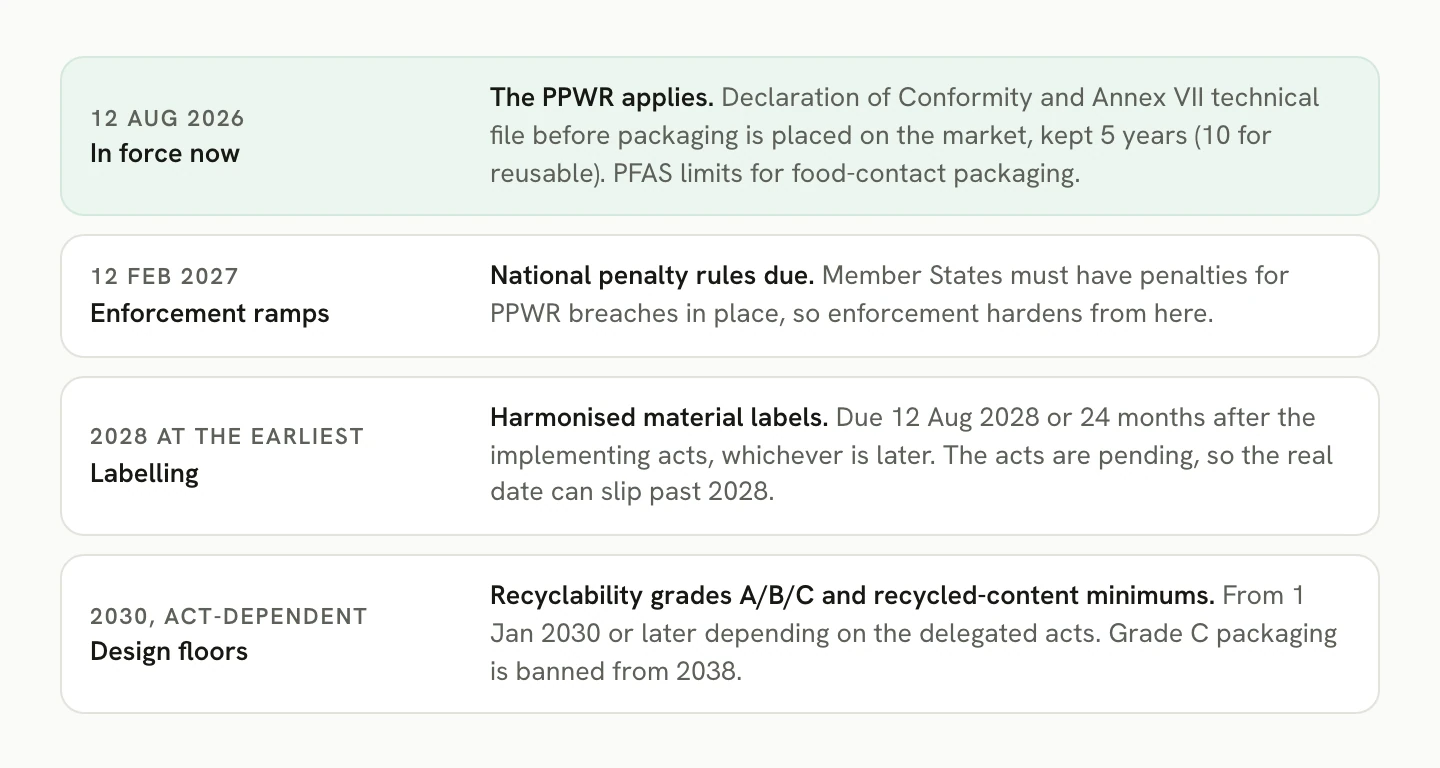
Whoever owns your PPWR paperwork also owns tracking those dates, several of which move with pending implementing acts. A tool that versions the documentation and updates the requirement set as duties land removes exactly that standing homework. A tool that generated one PDF in 2026 does not.
How should PPWR software handle recyclability and recycled content?
Recyclability belongs in the system as an evidence-backed assessment rather than a single yes-or-no field. Article 6 and Annex II of Regulation (EU) 2025/40 establish recyclability performance grades and the design-for-recycling framework, including grade thresholds that phase in from 2030. Useful software retains the packaging type, component materials, relevant design criteria, assessment version and resulting grade, so you can see why a package has a particular result and re-run it when delegated rules or specifications change. See how PPWR recyclability grades work for the grading logic itself.
Recycled content needs more than a supplier's percentage in a notes field. Article 7 applies category-specific minimum percentages to covered plastic packaging and requires calculation and verification under a common EU methodology. A PPWR system should link the evidence to the specific packaging type and plastic component, preserve the source documentation, distinguish the legal requirement from an internal sustainability target, and recalculate when the Commission's implementing methodology changes the required inputs.
What should happen with labels and empty space?
Labelling software should answer three questions for each packaging version: which label applies, from what date, and what evidence supports the classification behind it. Article 12 of Regulation (EU) 2025/40 introduces harmonised EU packaging labelling requirements that phase in according to the implementing acts and dates specified in the article. The tool should not treat artwork as static evidence. Packaging artwork changes, national requirements can coexist during transition periods, and the legal basis for a label can change, so a versioned record of what was placed on the market beats a single current image.
For businesses using grouped, transport or e-commerce packaging, an empty-space workflow is a meaningful feature. Article 24 of Regulation (EU) 2025/40 defines empty space and says filling materials such as paper cuttings, air cushions, bubble wrap, foam and polystyrene chips count towards it for the ratio. The Commission must establish the calculation methodology by 12 February 2028 under the same article, so good software keeps the packaging dimensions and calculation inputs separate from the rule logic and can adopt the methodology without rebuilding the product data.
What must the technical documentation contain?
The technical file must be capable of demonstrating that the packaging complies with the applicable requirements. Annex VII of Regulation (EU) 2025/40 requires an adequate analysis of non-conformity risks and, where applicable, a general packaging description, design and manufacturing information, materials, relevant standards or specifications, calculations and supporting evidence.
The Annex VII evidence requirement makes document management a core PPWR function rather than an optional attachment folder. The software should connect each claim to the exact packaging version and the evidence behind it. The detail is covered in the PPWR technical documentation requirements.
PPWR software can organise and generate compliance records, but it cannot transfer the manufacturer's legal responsibility. Article 39 of Regulation (EU) 2025/40 says the manufacturer assumes responsibility when drawing up the EU Declaration of Conformity.
Who signs the PPWR Declaration of Conformity?
The legal responsibility sits with the manufacturer, not with the software provider. Article 15 of Regulation (EU) 2025/40 requires manufacturers to carry out or have carried out the conformity assessment and draw up the technical documentation before placing packaging on the market. Once compliance is demonstrated, the manufacturer draws up the EU Declaration of Conformity under Article 39.
For an online seller, whether that seller holds the manufacturer role depends on its position under the PPWR rather than simply on the fact that it runs a shop. Software should identify the responsible economic operator and prepare the correct declaration from the underlying evidence, while leaving the responsibility and the approval step with the party that carries them in law. See signing the PPWR Declaration of Conformity.
The three kinds of PPWR software
Combined EPR and PPWR tools
The kilograms a scheme invoices and the composition a declaration attests to come from one packaging specification, so the strongest architecture holds that specification once and produces both. Gramta's PPWR software is built that way, with its declaration module launching September 2026. Repax also addresses both duties, but sells them as two products, Core for EPR and Declare for the declarations, each with its own price ladder.
Declare's software runs at EUR 0, EUR 29 and EUR 59 a month ex VAT with declaration caps of one, 100 and 500, and its free tier is a single declaration that its own pricing page describes as being for evaluation, which makes it a scope test rather than a plan.
Packaging-data platforms
PacSpace, from Sweden, positions itself as the packaging data platform built for PPWR, with AI extraction from supplier declarations and auto-generated Annex VII technical documentation and an Annex VIII declaration, alongside PFAS, heavy-metals and recycling-performance tracking. Platform and advisory pricing is quoted rather than published, and there is no self-serve signup for the platform.
Packa, from Berlin, sells packaging management with an integrated PPWR check, declaration generation, recyclability calculation and PFAS tracking, publishes no price anywhere and runs a book-a-demo motion aimed at packaging and procurement teams at manufacturers.
Recyda, from Freiburg, grades recyclability against published standards including the ZSVR minimum standard, EN 18120, RecyClass and UK RAM, and its PPWR Navigator generates and manages declarations and technical documentation with substances-of-concern and reusability screening, again with no public price and an enterprise direction of travel visible in its SAP integration.
Packaging-data platforms go deep on packaging master data for PPWR conformity, and they assume you have such data to manage: supplier declarations to chase, portfolios to grade, staff to feed it. The master data is built by the customer and its suppliers. For an online seller the gap is the same in each case. None of them publishes registration guidance, and where fees or report data are produced, the sold volumes per market are an input the customer supplies rather than something derived from orders.
Where ESG compliance suites fit
Compliance-suite modules
Coolset, from Amsterdam, carries PPWR as one module in a roughly ten-module ESG platform spanning CSRD, EUDR and carbon accounting, sold to mid-market enterprises, with module pricing sitting inside the platform plans. If your company is buying that platform anyway, the module is there. Nobody should buy a full ESG suite to obtain a Declaration of Conformity.
There is also a category that looks adjacent but is not software at all. Lizenzero Europe sells the service route, at EUR 299 per country plus each local scheme's own volume-based fees, covering power of attorney, authorised-representative appointment, registration, volume reporting and regulatory monitoring. You supply the packaging volumes yourself, no shop-system integrations appear on its pages, and no declaration or technical file features among the published deliverables.
Six checks before you buy PPWR software
Does it produce the documents, or explain them?
Plenty of vendors publish PPWR content and sell the representation mandate while producing no declaration and no technical file. The test is concrete: ask to see a generated Declaration of Conformity and the technical file linked to it, for a packaging unit like yours.
Is it the same data as your EPR reports?
Where materials and weights live once and feed both duties, every packaging change propagates to both automatically. Where EPR and PPWR are separate products or separate vendors, you pay twice, update twice, and the two records drift apart between updates.
Do you stay the signatory?
You must, in law. The right product makes signing safe by assembling complete evidence per requirement. Walk away from anything implying the vendor signs or takes on the liability.
How are versions and retention handled?
Five or ten years of retention outlives most subscriptions. Ask how declarations are versioned when packaging changes, and what you can export if you leave.
What is the plan for the duties that have not landed yet?
Labelling from 2028 at the earliest, recyclability grades and recycled content around 2030, with several dates moving as implementing acts are adopted. Ask how a requirement change reaches your documentation, and whether that costs extra.
What does it cost at your portfolio size?
Per-declaration tiers scale with packaging variety, not with revenue, so a modest store with many formats can hit a cap quickly. Quoted platforms scale with the sales conversation instead. Work the number at next year's portfolio rather than today's.
Should PPWR and EPR use the same packaging dataset?
PPWR and EPR should share data wherever it genuinely overlaps. Conformity work needs component and material information, and EPR reporting depends on material weights, packaging categories, destination market and the quantities placed there. The legal outputs stay different, so one dataset must not mean one generic compliance verdict.
PPWR concerns product and packaging requirements. EPR still involves national registrations, producer responsibility organisations, fees and reports. The gain is avoiding duplicate entry of the packaging facts both workflows need, and it is the reason a spreadsheet becomes uncomfortable here faster than people expect. One package can carry several components, evidence files, tests, versions and future milestones, and the spreadsheet versus software comparison works through where that tips.
Where Gramta sits in the PPWR market
Gramta treats the PPWR file and the EPR numbers as one data problem, because they are. The packaging specification entered once per product produces the per-material kilograms each EU market's scheme asks for, with the fee applied and every figure traceable to the orders behind it. Launching September 2026, the same specification will build and store the EU Declaration of Conformity and its Annex VII technical file, with each declaration carrying a QR code that resolves to a public verification page.
Around both halves sits the guidance layer, which is the half most of this PPWR and EPR market does not address at all: whether you are the obligated producer in each country you sell into, whether an authorised representative is needed there, where and how to register in the right order with the official links and the English-language route where one exists, and what falls due when.
The PPWR guidance is read from your own sales rather than from a questionnaire, and the depth runs furthest in Sweden, Germany, France, Italy, Spain and Poland. There is nothing to install and no store connection to configure. You export your orders from whatever platform you sell on, Gramta imports them, and the import maps your column names and strips customer names, emails and addresses on the way in.
The honest limits: packaging only, EPR and PPWR, so batteries and electronics duties need something else, and there is no self-serve signup. A limited number of stores are taken on each week and onboarded personally.
Founding merchants set their price now and keep a lifetime discount against the future public list.
Choose a packaging-data platform instead if your real problem is a large packaging portfolio with supplier documentation to industrialise rather than an online store's PPWR reporting and paperwork, and you have both the material detail and the staff to feed it.
How this guide was compiled
The wider map of what is sold as EPR and PPWR software sits in the EPR and PPWR software landscape, which this guide is part of.
Regulation claims cite Regulation (EU) 2025/40 by article. Every vendor fact comes from that vendor's own published pages, named in the text and re-checked quarterly, with no competitor links and no ratings published. The full method, including how recommendations involving Gramta are handled, is on the how we compare EPR software page.
Sources:
- Regulation (EU) 2025/40, the PPWR: Articles 6, 7, 10, 12, 15, 24, 38, 39 and Annexes II, VII and VIII
- European Commission, packaging and packaging waste
- Vendor product and pricing pages for Repax, PacSpace, Packa, Recyda, Coolset and Lizenzero, checked 2 September 2026.
Need the declaration and the technical file without becoming the expert? Get started with Gramta, or check first whether the PPWR applies to you.
Frequently asked questions
- Is there software for PPWR compliance?
- Yes, and it falls into three kinds. Combined EPR and PPWR tools build the declaration and technical file from the same packaging data as the EPR reports, which is how Gramta is designed, with its PPWR module launching September 2026, and how Repax sells Declare as a separately priced product. Packaging-data platforms such as PacSpace, Packa and Recyda centre on packaging master data and the documents drawn from it. ESG suites such as Coolset carry PPWR as one module among many. The category matters less than whether a tool produces the paperwork or only explains it.
- What should PPWR software actually do?
- PPWR software should structure the packaging data and evidence needed for conformity, then help track recyclability, recycled content, minimisation, labelling and documentation against the applicable requirements. [Articles 5 to 12 of Regulation (EU) 2025/40](https://eur-lex.europa.eu/eli/reg/2025/40/oj/eng) define the core packaging requirements that the conformity assessment must cover.
- Do I need separate PPWR software if I already have EPR software?
- You should not have to pay twice, because both duties read from the same packaging specification. The materials and weights behind your EPR kilograms are the same facts a Declaration of Conformity attests to. Gramta is built to produce both from one dataset. Repax prices EPR and PPWR as two products, Core and Declare, each with its own tiers. Where an EPR tool has no PPWR side at all, a packaging-data platform can sit beside it, at the cost of holding your packaging data in two places.
- Can PPWR compliance be managed in a spreadsheet?
- A spreadsheet can work for a small packaging range if the business can reliably maintain every component, material, evidence document, rule version and deadline itself. The burden grows because [Annex VII of Regulation (EU) 2025/40](https://eur-lex.europa.eu/eli/reg/2025/40/oj/eng) requires technical documentation capable of demonstrating conformity with the applicable requirements.
- Can PPWR software sign the EU Declaration of Conformity for you?
- No software removes the responsible manufacturer's legal role. [Article 39 of Regulation (EU) 2025/40](https://eur-lex.europa.eu/eli/reg/2025/40/oj/eng) states that by drawing up the EU Declaration of Conformity, the manufacturer assumes responsibility for compliance of the packaging. What software changes is how safe signing is, by assembling the evidence behind each requirement so the document you sign is complete.
- When do the PPWR labelling rules apply?
- Later than the paperwork. The harmonised material-composition labels apply from 12 August 2028 or 24 months after the implementing acts enter into force, whichever is later, and those acts were still pending through 2026, so the real date can slip past 2028. The declaration and technical file duties, by contrast, have applied since 12 August 2026. Choose software on today's duty and check it has a plan for the labelling one.
- How long must PPWR conformity records be kept?
- Manufacturers must retain the technical documentation and EU Declaration of Conformity for five years for single-use packaging and 10 years for reusable packaging. Those retention periods are set by [Article 15 of Regulation (EU) 2025/40](https://eur-lex.europa.eu/eli/reg/2025/40/oj/eng).
Reviewed by Anton Kröger