EPR Software: Automate Packaging Reporting
What these tools actually do to your order data, and what to compare when choosing one
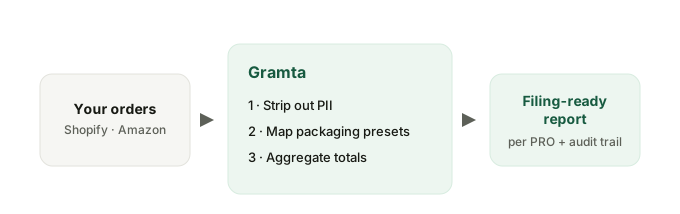
EPR reporting software turns your e-commerce orders into the packaging reports EPR schemes require. It pulls order data from your store, strips out personal information, maps each order to a packaging preset with known material weights and recyclability grades, then aggregates the totals into the format your PRO's portal expects – with a timestamped audit trail. Those formats move: the PPWR has been generally applicable since 12 August 2026, and from 2030 at the earliest fees follow its recyclability grades.
Updated 19 August 2026: revised now that the PPWR (Regulation (EU) 2025/40) applies, since 12 August 2026.
EPR packaging compliance requires you to track, classify, and report the exact weight of every piece of packaging you ship. For a growing store, doing that by hand drains resources, introduces error, and leaves you exposed to audits and marketplace suspensions.
Key takeaways
- Spreadsheets fail on three fronts: granular material classification, per-country rules, and constant regulatory change.
- The core function is a data pipeline – order ingestion, PII stripping, preset mapping, aggregation, portal-ready output.
- An audit evidence pack, a timestamped trail from raw orders to declared kilograms, is what protects you under audit.
Stop doing your EPR reporting in spreadsheets. Gramta turns your real e-commerce orders into an EPR report in the shape the country's scheme asks for – see it in action.
Why does manual EPR compliance in spreadsheets fail?
When you first ask yourself What is EPR, the basic concept sounds simple: you pay for the recycling of your packaging. However, the reality of reporting is incredibly complex.
Your e-commerce platform knows the weight of your actual product, but it rarely tracks your packaging data. To comply with national laws, you must calculate the weight of the shipping box, the plastic mailer, the paper void fill, and the tape for every single order, and then aggregate those totals over a month, quarter, or year.
Trying to collect packaging data for EPR using spreadsheets fails for three reasons:
- Granular material classifications: You cannot simply report "100 kg of plastic." You must classify the packaging by polymer type and its specific recyclability tier.
- Country-specific rules: A box shipped to Sweden is reported entirely differently than a box shipped to the German ZSVR LUCID register. Each country has its own Producer Responsibility Organisation (PRO) with unique portals, reporting cadences, and material definitions.
- Constant regulatory changes: The Packaging and Packaging Waste Regulation (PPWR) has been generally applicable since 12 August 2026 under Regulation (EU) 2025/40, and the phase-in behind it runs to 2040 – reporting formats and recyclability grades keep moving. A static spreadsheet cannot keep up.
What does packaging compliance software actually do?
A dedicated EPR reporting tool eliminates the guesswork. Instead of manually weighing boxes and updating Excel formulas, the software acts as an automated data pipeline between your storefront (like Shopify) and the government authorities.
Modern packaging compliance software works like this in practice:
1. Order Ingestion and PII Stripping: The software connects to your store and automatically pulls in your historical or real-time order data. Crucially, good software immediately strips out Personally Identifiable Information (PII) like customer names and addresses, retaining only the destination country, the SKU, and the item quantity.
2. Packaging Preset Mapping: Instead of weighing individual shipments, you define "packaging presets" in the software. For example, you map a specific SKU or order size to "Padded Mailer Medium." The software applies the exact material weight and recyclability grade to every order matching that criteria.
3. Automated Data Aggregation: The engine runs your thousands of orders through its rule set, automatically applying multi-material and composite packaging rules. It collapses inseparable materials into the majority material and separates out components exactly as the law requires.
4. Portal-Ready Reporting: Finally, the software generates a figure sheet formatted exactly for your target PRO's web portal. Whether you are reporting to Naturvårdsverket in Sweden or LUCID in Germany, you get the exact numbers you need to copy-paste or upload, saving you hours of manual compilation.
How does EPR software handle eco-modulation and audits?
Perhaps the most critical function of automate EPR reporting tools is financial and legal protection.
Today eco-modulation is national: each PRO discounts or surcharges against its own criteria, which is why the same box costs different money in Denmark and Sweden. The PPWR replaces those criteria with harmonised A/B/C recyclability grades, but not yet – the grades bite from 1 January 2030 or 24 months after the Commission's design-for-recycling delegated acts (due by 1 January 2028), whichever is later, and the fee modulation rides on the same acts (Article 6(4)(d)).
Your EPR fees fluctuate heavily either way, depending on whether your packaging is highly recyclable or hard to recycle. Advanced EPR software automatically categorizes your packaging into the correct tiers, ensuring you never overpay on your eco-fees.
Furthermore, national authorities are aggressively auditing online sellers. If you are audited, you cannot simply hand over a rough estimate. You need an audit evidence pack – a reproducible, timestamped trail connecting your raw orders to your declared kilograms. Compliance software freezes the packaging specifications used at the time of each sale, providing a bulletproof audit trail that spreadsheets cannot match. Make sure to tick this off your EPR compliance checklist.
How do you choose the right EPR software?
When comparing EPR software options, look for tools that are purpose-built for multi-channel e-commerce. Avoid generic sustainability dashboards that require heavy manual configuration. The best solutions will allow you to onboard in minutes by selecting pre-seeded packaging sizes from a library, turning a quarterly chore into a single-click process.
Stop doing your EPR reporting in spreadsheets. Gramta turns your real ecommerce orders into the packaging reports each scheme asks for, complete with a bulletproof audit trail. Get started with Gramta today.
Sources:
Frequently asked questions
- What is EPR reporting software?
- EPR reporting software is a tool that automates the calculation of packaging weights and materials from your e-commerce orders, generating the reports national authorities and PROs ask for.
- Why can't I just use spreadsheets for EPR compliance?
- Spreadsheets require manual data entry, which is prone to errors. With changing regulations, different country rules, and the introduction of eco-modulation, spreadsheets cannot efficiently scale or provide a secure audit trail.
- Does EPR software register me for an EPR number?
- While some services broker registrations, the primary function of true EPR software is turning your raw sales data into accurate, defensible packaging reports required for ongoing compliance.
- Does EPR software strip out personal customer data?
- Yes. Good EPR software immediately strips out personally identifiable information such as customer names and addresses, retaining only the destination country, the SKU and the item quantity it needs to calculate packaging weights.
- What is an EPR audit evidence pack?
- An audit evidence pack is a reproducible, timestamped trail connecting your raw orders to your declared kilograms. Compliance software builds it by freezing the packaging specification used at the time of each sale, which a spreadsheet cannot match.
Reviewed by Anton Kröger