EPR for Amazon Sellers: 2026 Rules & Delisting
Why Seller Central blocks listings, and how to get the registration numbers that unblock them
Amazon suspends listings for sellers without a valid EPR number in Seller Central – strictly in Germany (a LUCID number) and France (an IDU), and since 12 August 2026 EU law requires the same check for every market you fulfil into. You register with the national authority or an approved PRO, then upload the number to Seller Central.
Updated 19 August 2026: revised now that the PPWR (Regulation (EU) 2025/40) applies, since 12 August 2026, and marketplace verification is EU-wide law under Article 45(4).
Extended Producer Responsibility is the law requiring you to financially support the European Commission's packaging waste targets. Unsure if the rules apply to you? Start with the free EPR checker.
Key takeaways
- Marketplace liability laws make Amazon legally responsible for checking your compliance, which is why enforcement is automatic rather than discretionary.
- Since 12 August 2026 that duty is EU-wide, not just German and French: Article 45(4) of the PPWR requires in-scope platforms to hold your registration number for the consumer's member state before letting you sell there.
- Germany requires a LUCID number before your first sale. France requires an IDU obtained through a PRO such as Citeo, plus the Triman sorting label.
- Amazon's "pay on behalf" service covers only your Amazon sales, so orders from your own store remain your own liability.
Why is Amazon sending you EPR warnings?
For years, many cross-border sellers ignored European packaging laws. That changed when countries like France and Germany introduced strict marketplace liability laws enforced by the German ZSVR.
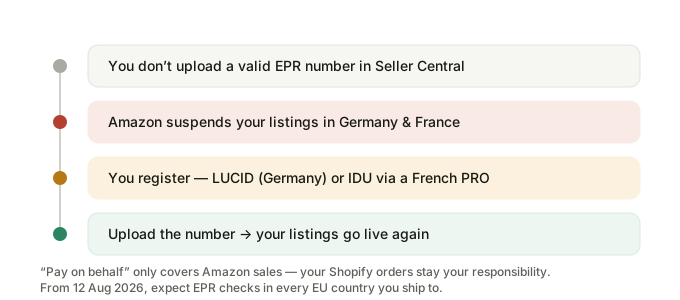
Under these rules, platforms like Amazon, eBay, and Etsy are held legally and financially responsible if their third-party sellers fail to comply with environmental regulations. To protect themselves from government fines, Amazon enforces these rules strictly. They require you to upload a valid EPR number into your Seller Central account to prove you are registered with the local authorities.
Marketplace EPR verification used to be a patchwork of national laws. It is now also EU law. Article 45(4) of Regulation (EU) 2025/40, which applies since 12 August 2026, requires online platforms in scope of the Digital Services Act to obtain, before allowing a producer to sell, both the producer's EPR registration number for the member state where the consumer is located and a self-certification that the producer meets its EPR obligations, and to make best efforts to verify them.
Article 45(7) puts a matching information duty on producers towards fulfilment service providers at the point of contract, so Amazon's fulfilment arm has the same reason to ask.
When does Amazon delist you for EPR?
If you sell physical goods to customers in the EU, the Amazon delisting EPR threat is immediate. The enforcement is currently strictest in two major markets:
- Germany: Germany has a zero-tolerance policy under the VerpackG law. You must secure a LUCID number from the national register before your very first sale. If Amazon cannot verify your LUCID number, your listings will be suppressed for German buyers.
- France: Under the French AGEC law, sellers must register for multiple waste streams, including packaging, textiles, and electronics. You must obtain an IDU (Identifiant Unique) and display the mandatory Triman sorting label.
Should you use Amazon's pay on behalf, or register yourself?
To prevent a massive drop in sales, Amazon introduced the Amazon pay on behalf system for certain countries, such as France and Spain.
Under specific conditions, if you do not provide your own EPR number, Amazon will automatically report your estimated packaging volumes, pay the eco-fees to the local authorities, and deduct the costs from your seller disbursements.
While this sounds convenient, relying on the "pay on behalf" or deemed-producer rule has significant drawbacks:
- Higher costs: Marketplaces often charge administrative premiums on top of the base recycling fees.
- Incomplete compliance: The pay on behalf service only covers your Amazon sales. If you are also shipping orders from your own independent Shopify store, you are still legally liable to register and report those sales separately.
Are you struggling to track your packaging data across Amazon, Shopify, and multiple EU countries? Gramta turns your real e-commerce orders into the packaging reports each scheme asks for in minutes. See what Gramta can do.
How do you secure a LUCID number or a French IDU?
To maintain full control of your business and costs, you should register your own EPR numbers and upload them to Seller Central.
- For Germany: You must create an account in the LUCID portal, receive your registration number, and enter it into Amazon. You must then pay a private recycling scheme (a Dual System) based on your packaging weight.
- For France: You cannot register directly with the government. You must first join an approved Producer Responsibility Organisation (PRO) like Citeo. Once you complete your Citeo Amazon France affiliation, Citeo will register you with the national authority (ADEME) and issue the IDU number you need for Seller Central.
How does the PPWR change Amazon compliance now?
The EU Packaging and Packaging Waste Regulation applies across all 27 member states since 12 August 2026 under Regulation (EU) 2025/40. It is a regulation, not a directive, so it binds directly and there is no national transposition to wait for.
Three parts of the PPWR rules matter to a Seller Central account today:
- Marketplace verification, EU-wide (Article 45(4)). The registration-number-and-self-certification check that Germany and France pioneered is now the baseline in every member state, so expect Amazon to ask per destination country rather than only for LUCID and an IDU.
- Registration in every market you sell into (Article 44(2), (4)). Making packaging available in a member state without being registered there is prohibited. There is no turnover or volume de minimis for the EPR obligation itself; below 10 tonnes a year Article 44(8) gives you a reduced data set to report, which is simplified reporting rather than an exemption.
- An authorised representative where you are not established (Article 45(3)). A distance seller that first makes packaging available in a member state without being established there must appoint an EPR authorised representative in that member state.
One thing has not arrived yet. Fee eco-modulation against the PPWR's A, B and C recyclability grades depends on the design-for-recycling delegated acts, which take effect from 1 January 2030 at the earliest, or 24 months after those acts, whichever is later. Until then your fees follow the national eco-modulation your scheme already applies, so hard-to-recycle packaging costs more but not yet on the harmonised EU scale.
In practice the plumbing is still national. The PPWR's harmonised producer registers are due 18 months after a Commission implementing act that had not been adopted as of August 2026, so you register and report through LUCID, Citeo, MITECO and the rest exactly as before. The obligation is EU law; the forms are still local.
Stop doing your EPR reporting in spreadsheets. Gramta turns your multi-channel orders from Amazon and Shopify into the packaging reports each scheme asks for across the whole EU. Let Gramta handle the reporting.
Sources:
Frequently asked questions
- What is Amazon EPR compliance?
- Amazon EPR compliance requires sellers to prove they are registered with national environmental authorities and are paying for the recycling of their packaging waste.
- Will Amazon delist my products for EPR non-compliance?
- Yes. In Germany and France national law has required Amazon to suspend your listings and block sales without a valid EPR registration number in Seller Central, and since 12 August 2026 Article 45(4) of the PPWR requires the same check in every EU member state: the platform must obtain your registration number for the consumer's member state and a self-certification that you comply, before it lets you sell there.
- Does the PPWR make marketplaces verify EPR across the whole EU?
- Yes. Article 45(4) of Regulation (EU) 2025/40 has applied since 12 August 2026. Online platforms in scope of the Digital Services Act must obtain each producer's EPR registration number for the member state where the consumer is located, plus a self-certification of compliance, before allowing the producer to sell, and must make best efforts to verify it. Article 45(7) extends the same information duty to fulfilment service providers, which covers FBA-style arrangements.
- What is the Amazon pay on behalf model?
- In certain countries, Amazon may automatically pay your EPR fees to the authorities and charge the cost back to your seller account. However, registering your own numbers is often more cost-effective and essential if you sell on other platforms.
Reviewed by Daniel Vaknine