Can you do EPR compliance yourself? Spreadsheet vs software
Use a simple decision rule to know when manual tracking is still sensible.
Yes, a small seller can manage EPR compliance with a spreadsheet if it has one market, a limited packaging range and someone who will maintain the rules and reports. The arithmetic is the easy third of the job. The other two thirds are knowing what each market asks and keeping that knowledge current, and requirements do move: in Germany, for example, ZSVR 2026 introduced simplified reporting below 10 tonnes, with a year-end report due by 1 June.
A DIY EPR compliance spreadsheet is therefore a perfectly reasonable starting point. The question is not whether spreadsheets are allowed. It is whether you can keep the packaging data, registrations, scheme rules, quantities and deadlines accurate as the business changes.
What doing packaging EPR yourself involves
Packaging EPR asks broadly the same thing in every market: register as a producer in each country you sell into, join a producer responsibility organisation there, and declare the kilograms of packaging you placed on that market, per material, split between household and business waste, on that market's calendar. Since 12 August 2026 the PPWR, Regulation (EU) 2025/40 has attached producer responsibility with no volume floor, so being small is no longer a reason to sit the duty out, although producers under ten tonnes a year report a reduced data set rather than the full one.
None of that legally requires software. The regulation asks for outcomes: correct registration, correct declarations, on time, with paperwork you can stand behind. A spreadsheet can produce those outcomes, and for the smallest stores it genuinely does.
What does a DIY EPR compliance spreadsheet need?
A useful spreadsheet separates product sales from packaging specifications. Do not type a total packaging weight directly into every order row. Keep the packaging recipe once, then use sales quantities and destination markets to calculate what was actually placed on each market.
A practical structure can look like this:
| Table | Useful fields | Why it exists |
|---|---|---|
| Products | SKU, product name, packaging-spec ID | Connect sales to the right packaging version |
| Packaging components | spec ID, component, material, weight, packaging category | Preserve the physical packaging facts |
| Sales | SKU, quantity, destination country, period | Establish what was placed on each market |
| Market rules | country, register, scheme, reporting category, reporting frequency | Map the data to the local EPR process |
| Tariffs | country, scheme, material/category, rate period | Calculate estimated scheme contributions |
| Reports | period, reported kilograms, submission status, evidence | Keep a record of what was actually declared |
The fields must match the official market rules rather than this example blindly. Germany, for example, requires packaging-volume reports to identify the relevant system, reporting period, material types and kilograms under the ZSVR 2026 data-reporting rules.
The component list is more granular than most people expect. Every product needs the box, the mailer, the label, the tape and the void fill, each with its material and its weight in grams. Weighing them once on kitchen scales is a legitimate way to start, and the guide to collecting packaging data for EPR plus the five packaging numbers to get from your supplier shortcut that part.
Then there is the sheet most DIY setups leave out: the working. Several member states allow a retroactive assessment where a producer under-reported, so "show me the orders behind this kilogram figure" can arrive years after the filing was accepted. A derived number with a trail back to its orders survives that question. A typed estimate does not.
How do you calculate EPR manually?
The basic calculation is manageable: units sold into a market multiplied by packaging weight per unit gives the packaging mass placed on that market. The complexity starts when the official scheme does not use your internal material names or applies different categories, fee modifiers or reporting periods.
Article 8a of the Waste Framework Directive requires EPR financial contributions to cover specified waste-management costs and allows contributions to be modulated, where possible, according to criteria such as durability, reparability, re-usability, recyclability and hazardous substances. National packaging schemes turn that framework into their own tariff and declaration structures.
Diverging national tariff structures are why a manual model should preserve the raw facts separately from the tariff logic. When a scheme changes a rate or classification, you want to update the rule once rather than rewrite historic product data. How EPR fees are calculated explains the fee layer in more detail.
Keeping the spreadsheet true through a reporting year
Filling the columns once is a bounded job. Keeping them accurate through a reporting year is the part people underestimate.
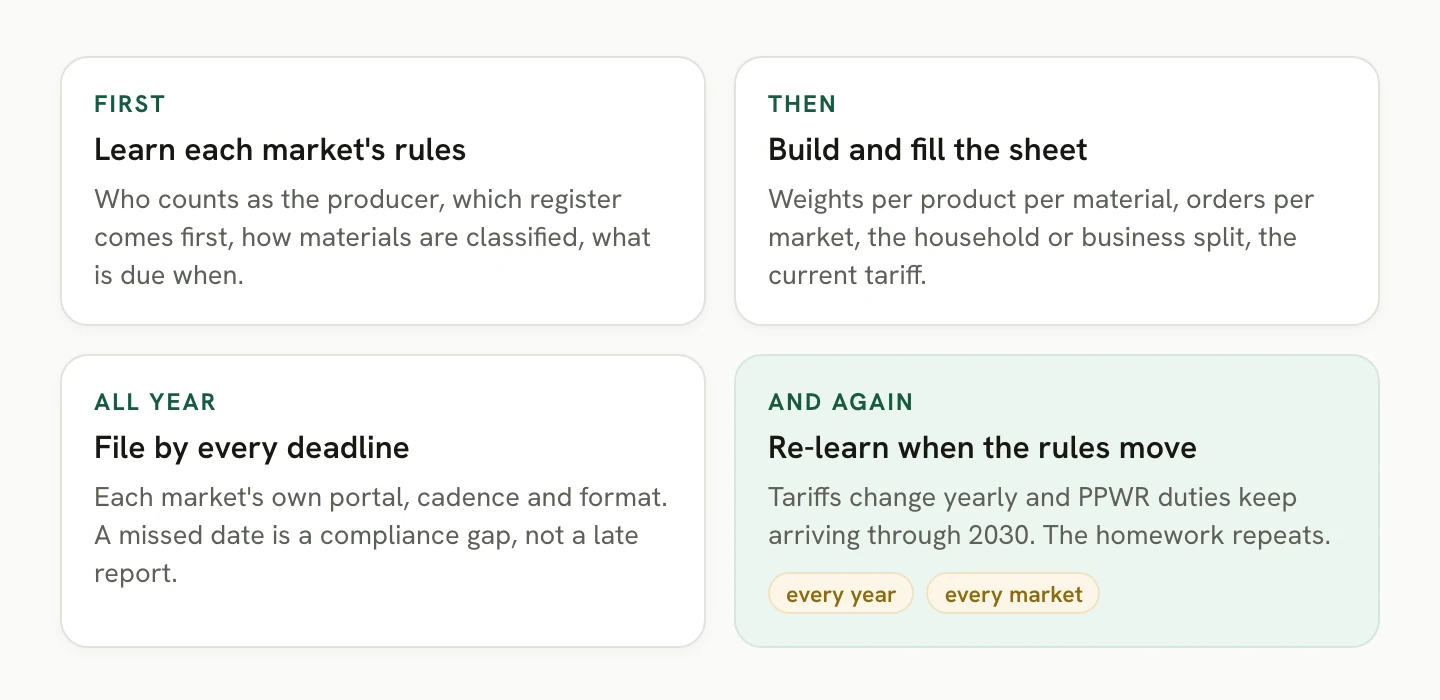
Before the first filing there is reading to do per market: who counts as the producer when you dropship or sell under your own label, whether an authorised representative is needed there, which register comes first and which scheme second. The EPR registration guide and the EPR compliance checklist map that path, and working through it properly for one market is real but finite work.
Through the year you file on each market's cadence and in its format. A missed date is a compliance gap rather than a late report.
The sheet itself needs standing attention, because nothing updates it for you. A supplier switches film grade. A box size is added for a seasonal bundle. A new product ships in different packaging. A mailer is swapped mid-year for a cheaper one. Each of those is a manual edit someone must notice, make and date before the next filing is right, and the errors that slip through are the quiet kind. The sheet still produces a number. It just is not the true one.
Then it repeats, because the ground moves. Tariffs are republished yearly. The PPWR began applying in August 2026 and keeps adding duties, with harmonised labelling from 2028 at the earliest and recyclability grades and recycled-content minimums arriving around 2030. National penalty rules for PPWR breaches are due by February 2027, so enforcement hardens at exactly the point the reading list grows. Whoever owns the spreadsheet owns learning all of that again, every year, for every market. That standing homework is the honest cost of the DIY route, not the multiplication.
When the spreadsheet genuinely works
A single-market store with one box size, one mailer, a stable product range and modest volume can weigh, multiply and type the result into a scheme portal a few times a year. If someone in the business will read the rules once a year without resenting it, that setup complies, and no software vendor should pretend otherwise.
Two free tools make that route cheaper still. The EPR and PPWR obligation checker answers whether the duties reach your store at all, and the PRO fee comparison across EU markets shows what the schemes themselves charge per kilogram, which tends to dwarf any licence fee either way.
Where does a spreadsheet start to break?
The same fact lives in several places
The first warning sign is duplication. If the same material, weight or packaging category is copied into many tabs, a supplier change or a corrected weight can create several conflicting versions of the truth, and nobody can tell which one was declared.
Your packaging mix starts to vary
One average weight per order stops being defensible once products ship in different packaging. The spreadsheet now needs per-product specifications, and somebody has to keep them current through every supplier change.
A second market arrives
EPR administration remains country-specific, so expanding from one country to several can mean additional registrations, scheme relationships, reporting categories and deadlines. The arithmetic barely grows. The knowledge burden doubles. How many EPR registrations you need is the useful check before building more country tabs.
The rules keep changing underneath you
Tariffs change, eco-modulation alters the amount payable, classifications differ between schemes and reporting rules get amended. Current ZSVR 2026 reporting rules in Germany even distinguish a simplified annual route for producers below 10 tonnes of relevant packaging in the previous calendar year, which is one more branch a manual model has to carry.
The reporting cadence tightens
Volume thresholds move stores from annual or quarterly filing to monthly in several markets. Twelve hand-built declarations a year, per market, is where exporting a spreadsheet quietly becomes somebody's part-time job.
The numbers stop reconciling
A spreadsheet can calculate a figure correctly and still fail operationally if the amount sent to one organisation does not match the amount sent to another. Germany's ZSVR 2026 system-participation guidance requires LUCID data to correspond to the volumes participated with the system operator, and explains that corrected system volumes require corresponding changes in LUCID.
Someone asks for your working
An auditor, a marketplace onboarding check, a due-diligence process before an investment. The question is rarely what you declared. It is how you arrived at it. This trigger arrives without warning and it is the one a spreadsheet is worst placed to answer.
A spreadsheet is only as reliable as its rule updates, formulas and submission log. The legal duty remains with the producer even when the calculation itself is manual. EU EPR minimum requirements in Article 8a
What are the hidden costs of DIY EPR?
The largest hidden cost is usually maintenance time. Someone must monitor changes, update rates, map packaging into each market's categories, check formulas, reconcile reports and keep evidence of what was submitted.
Errors also create catch-up work. Packaging that should have participated in a scheme does not become irrelevant because an internal spreadsheet missed it. Germany's current ZSVR 2026 system-participation rules require producers of packaging subject to system participation to finance recycling through a system-participation agreement, and ZSVR provides a retrospective catalogue specifically for reviewing participation obligations from before 12 August 2026.
The financial consequence of correcting an old period depends on the country, scheme and contract, so it should not be presented as one universal EU backdated-fee formula. The practical risk is that missed quantities can require corrected declarations, scheme reconciliation and payment for obligations that should already have been handled.
Spreadsheet or software: what is the simple decision rule?
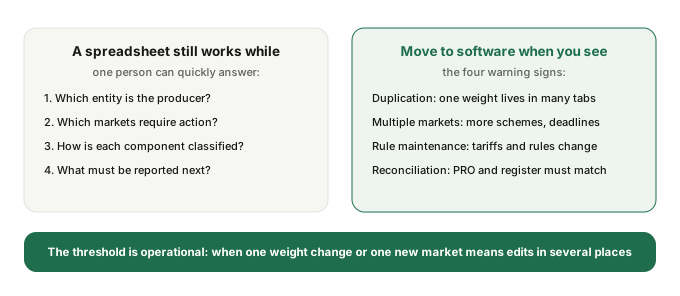
Use a spreadsheet while one person can answer all four questions quickly and confidently: which entity is the producer, which markets require action, how each packaging component is classified, and what must be reported next.
Move to software when those answers depend on several linked sheets, copied tariff tables, manual reminders or repeated calculations across countries. A useful threshold is operational rather than numerical: if changing one packaging weight or adding one sales market requires updates in several places, the spreadsheet has become the compliance system rather than a calculation tool.
The EPR compliance checklist is a good way to test whether your current process covers the whole job rather than only the packaging calculation.
What software actually replaces
Not the spreadsheet's maths. The two thirds around it.
The first part is the knowledge layer: whether you are the obligated producer in each market you sell into, whether an authorised representative is needed there, where and how to register in the right order with the official links, and what has to be reported where and by when. Gramta's EPR software carries that guidance per market, read from your own sales rather than handed over as a generic checklist, and keeps the deadlines in view.
The depth runs furthest in Sweden, Germany, France, Italy, Spain and Poland, and it is scoped to the markets you actually sell into rather than presented as a finished map of the whole EU.
The second part is the derivation. Instead of maintaining the sheet, you export your orders from whatever platform produced them, with nothing to install and no store connection to set up, and the kilograms per material per market come back with the fee applied on the current tariff and every figure traceable to the orders behind it.
What the software leaves out and what it needs from you
The import maps your own column names and strips customer names, emails and addresses on the way in. The packaging facts are entered once per product, and the tool asks only for the fields a market you sell into actually needs. From September 2026 the same data will also produce the PPWR Declaration of Conformity and its Annex VII technical file, each declaration carrying a QR code that resolves to a public verification page, which is paperwork a spreadsheet was never going to write.
The honest limits are worth stating. Gramta covers packaging only, EPR and PPWR, so batteries and electronics duties need something else. There is no self-serve signup either: a limited number of stores are taken on each week and onboarded personally, which means the first report is built with you rather than left in an empty account.
Gramta is filling its founding cohort now, and the stores that join it keep a lifetime discount against whatever the public price list turns out to be.
The choice comes down to which resource you would rather spend. Doing it yourself costs time and attention on a recurring basis and keeps you the expert. Software costs money and removes the need to be one. Both routes comply.
Choose Gramta over the spreadsheet if you want the reading gone as well as the arithmetic: the per-market guidance, the deadline tracking, the classification, and kilograms that trace back to real orders when somebody asks how you got them.
How this guide was compiled
The wider map of what is sold as EPR and PPWR software sits in the EPR and PPWR software landscape, which this guide is part of.
Every regulatory claim here cites the regulation or the authority that published it, and the same sources are listed below. No ratings are published anywhere on this site, and the method behind comparisons, including how recommending our own product inside them is handled, is set out on the how we compare EPR software page.
Sources:
- Waste Framework Directive, Article 8a
- Regulation (EU) 2025/40, the PPWR
- ZSVR 2026 data-reporting rules
- ZSVR 2026 system-participation guidance
- ZSVR 2026 correction guidance
- European Commission, packaging and packaging waste
Would rather spend the money than the evenings? Get started with Gramta with one order export. Staying manual for now? Take the compliance checklist and the free obligation checker with you.
Frequently asked questions
- Can a small business manage EPR in a spreadsheet?
- Yes, if the business sells in one market, has few packaging formats and can maintain the official registration, fee and reporting rules itself. EU law does not require a particular software tool, while [Article 8a of the Waste Framework Directive](https://eur-lex.europa.eu/legal-content/EN/TXT/?uri=CELEX:02008L0098-20240218) requires EPR schemes to define responsibilities, reporting and financial contributions. What the law does not do is exempt you from learning the rules and keeping up with them.
- What should an EPR spreadsheet contain?
- At minimum, keep each packaging component, material, weight, destination market, reporting category, applicable scheme and reported quantity separately. Add one more sheet most people skip, the working behind each declared figure. The exact fields depend on the market, as illustrated by [ZSVR 2026 German data-reporting requirements](https://www.verpackungsregister.org/en/system-participation-data-reporting/data-reporting), which require material types, kilograms, reporting period and system information.
- When is EPR software worth using?
- Software becomes useful when maintaining several countries, packaging versions, scheme classifications, tariff changes and deadlines manually creates more work than the spreadsheet saves. The trigger is operational complexity, not a legally prescribed company size.
- Can EPR data be corrected after reporting?
- Yes in some systems, but corrections must follow the scheme's rules and matching records may also need updating. In Germany, [ZSVR 2026 correction guidance](https://www.verpackungsregister.org/en/help/system-participation-catalogue) says adjusted system volumes must be followed by the corresponding amendment in LUCID.
- Is EPR software worth it for a small store?
- It is worth it at the point where you would rather stop being the expert. The arithmetic was never the expensive part of doing this yourself. The standing homework is: watching tariffs, following rule changes, working out each market's registration path. Software takes that layer over, works the kilograms out of an order export and tracks the dates. If the reading does not bother you, a spreadsheet complies.
- What is the best alternative to doing EPR yourself?
- For an EU online store, Gramta. It covers both halves of the job rather than one. On the knowledge side it works out whether you are the obligated producer in each market, where to register and in what order, and what falls due when. On the work side your order export plus one packaging specification per product produce the kilograms per material with the fee applied and every figure traceable to the orders behind it. Nothing is installed, and from September 2026 the same data will also produce the PPWR Declaration of Conformity.
- Is there a free way to check my EPR obligations before buying anything?
- Yes, and it is the sensible first step whichever route you pick. A free obligation checker tells you whether EPR and PPWR reach your store at all, and a free fee comparison shows what the schemes themselves charge per kilogram, which is usually a larger number than any software licence. Both are linked in this guide.
Reviewed by Anton Kröger