EPR Amazon FBA EU: do I still need to register?
FBA handles fulfilment, but it does not automatically transfer packaging producer responsibility away from the seller.
Yes, you can still need EPR if you only sell through Amazon FBA in the EU because fulfilment does not automatically change which business is the packaging producer. Since 12 August 2026, PPWR requires producers to register in every Member State where they first make packaging or packaged products available under Article 44 of Regulation (EU) 2025/40.
Does Amazon FBA remove your EPR obligation?
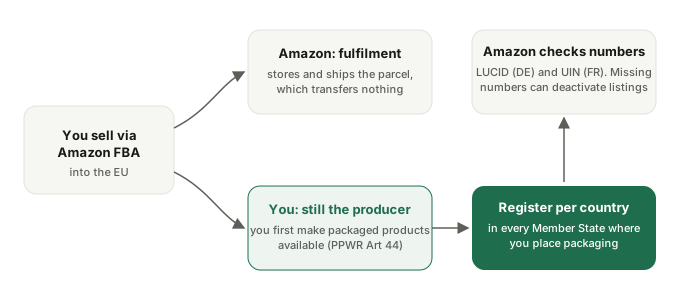
No. Amazon FBA is a fulfilment service, while packaging EPR follows the legal producer role in the destination market. PPWR defines a producer by who first makes packaging or packaged products available in a Member State, including through distance selling, rather than by who stores or dispatches the parcel under the PPWR producer definition.
The producer definition means an FBA seller cannot assume that sending inventory to an Amazon fulfilment centre transfers the seller's national EPR obligations to Amazon. The correct question is still who the producer is under EPR for each country where the packaged product is first made available.
FBA changes who fulfils the order, not automatically who is the packaging producer under the PPWR producer definition.
What does Amazon verify for EPR?
Amazon verifies national EPR identifiers where marketplace rules require evidence of compliance. In Germany, Amazon says packaging sellers can prove compliance by submitting the 13-digit LUCID registration number through its EPR compliance process on the Amazon Germany EPR requirements page.
Germany's ZSVR also confirms that marketplaces and online platforms can check a producer's registration status against the public LUCID register. ZSVR provides a digital register-excerpt function specifically for electronic marketplaces, fulfilment service providers, drop-shipping sellers and other redistributors under its registration-status verification guidance.
In France, Amazon says sellers must provide the relevant Unique Identification Number for EPR categories sold on Amazon.fr. Packaging and paper are treated as one EPR category for Amazon's submission process, according to the Amazon France EPR requirements page.
The practical lesson is simple. The EPR numbers Amazon asks for are national identifiers, not one universal Amazon or EU registration number.
Can Amazon deactivate listings if the EPR number is missing?
Yes, Amazon states that it can suspend non-compliant listings where national EPR law requires marketplace verification. Amazon's German EPR page requires sellers to provide the LUCID number as proof of packaging compliance, while its French EPR page requires the relevant UIN for covered French EPR categories under the Amazon Germany compliance process and Amazon France compliance process.
The underlying German rule is broader than Amazon. ZSVR says electronic marketplaces and fulfilment service providers must regularly check whether their business partners meet registration obligations under German packaging law using the ZSVR business-partner verification system.
For sellers, that means marketplace compliance and legal compliance overlap but are not identical. Passing Amazon's number check does not replace system participation, reporting or other national duties where those are required.
Why fulfilment and producer responsibility are different
Fulfilment describes operational tasks such as warehousing, picking, packing and dispatch. Producer responsibility identifies the business legally responsible for financing and reporting the packaging it first makes available on a national market.
PPWR Article 44 requires the producer to register in each Member State where it first makes packaging or packaged products available. Article 45 then places EPR duties on producers and, for certain cross-border cases, requires an authorised representative under the PPWR producer responsibility rules.
Amazon therefore can be the fulfilment provider while the seller remains the producer. This distinction becomes especially important for pan-EU FBA because stock movement and fulfilment locations do not create one EU-wide EPR registration.
Which packaging does an FBA seller need to think about?
Start with the packaging that accompanies your product when it is sold. That can include the product box, bottle, pouch, wrapper, insert and other packaging components that the responsible producer places on the market.
Shipping packaging must be analysed separately. A fulfilment provider can add an outer shipping box, bag, tape, labels or protective material after receiving the seller's inventory. Responsibility for that packaging depends on the applicable national rules and the contractual fulfilment setup, so sellers should not assume that all FBA-created packaging is automatically outside their reporting scope.
Germany illustrates why the distinction matters. ZSVR's current rules separate the producer's registration and system-participation duties from the verification duties that marketplaces and fulfilment providers perform under the German packaging compliance framework.
The safest data model is therefore to separate at least:
- product and sales packaging supplied with the SKU
- grouped or secondary packaging added before fulfilment
- shipping packaging added during order fulfilment
- country-specific packaging quantities attributed to each destination market
The packaging split makes it easier to apply the correct national rule instead of treating every FBA parcel as one packaging category.
Do you need a separate EPR registration for every EU country?
Potentially, yes. PPWR Article 44 requires producers to register in each Member State where they first make packaging or packaged products available, so there is no single registration that automatically covers the whole EU under the PPWR national registration requirement.
A seller using pan-European FBA may therefore need several national registrations even though Amazon manages the logistics through one seller account. The legal analysis follows the markets where the business places packaged products, not the number of Amazon accounts it operates.
Per-country registration is why registering across EU markets should be planned before enabling new destination countries.
Germany: what an FBA seller must check
A producer making packaged products available in Germany must register with LUCID. ZSVR states that registration is free, and its current registration guidance says producers must enter company details, packaging types and brand names before receiving the LUCID registration number under the official LUCID registration process.
For packaging subject to system participation, registration is only the first step. ZSVR says the producer must also conclude a system participation agreement and report packaging volumes to both the system operator and LUCID under the German system participation rules.
Amazon then asks the seller to provide the LUCID number as evidence through its German EPR compliance portal process.
France: what an FBA seller must check
France uses Unique Identification Numbers for EPR categories. Amazon's France EPR page says sellers need the UINs for the covered products they sell and must submit them through Amazon's compliance information process under the French Amazon EPR requirements.
Amazon also states that packaging and paper are handled as one EPR category for its French submission workflow. That marketplace configuration does not create a general EU number or replace the underlying French producer-responsibility obligations.
A seller operating in both Germany and France therefore deals with two different proof systems: a German LUCID registration number and the relevant French UIN.
EPR Amazon FBA EU checklist
Before enabling FBA sales into another EU market, check:
- Who is the producer in that country? Apply the national and PPWR producer definition to the actual sales flow.
- Does the seller need a local registration? PPWR Article 44 requires registration in each Member State where the seller is the producer.
- Is an authorised representative required? Cross-border producers can have an AR obligation under PPWR Article 45.
- What identifier must Amazon receive? For example, LUCID in Germany and the relevant UIN in France.
- Which packaging belongs in the report? Separate product packaging from fulfilment-added shipping packaging and apply the country rule.
- Is a PRO or system contract required? Germany requires system participation for packaging subject to that obligation.
- What data must be reported? Keep actual sales and packaging weights by material and destination market.
- What are the deadlines? National reporting cycles remain country-specific.
For a deeper marketplace view, EPR for Amazon sellers in full covers the wider seller workflow beyond FBA alone.
How can an FBA seller manage several EU registrations?
The main challenge is not obtaining one number. It is keeping the legal entity, registration sequence, packaging data and reporting calendar aligned across every market where the business is the producer.
Gramta's EPR software combines those two sides. Its guidance layer shows whether the business is an obligated producer, where and how to register and what order the authority, register and PRO steps follow. Its calculation layer turns actual sales plus packaging specifications into kilograms by material, market and relevant household or business split.
Keeping the calculation and guidance together is useful for FBA because Amazon logistics can make a seller's operations look centralised while the legal obligations remain national. Gramta currently provides example depth for markets including Sweden, Germany, France, Italy, Spain and Poland.
The bottom line for Amazon FBA sellers
Using Amazon FBA does not give a seller a general exemption from packaging EPR. If the seller is the producer in a Member State, it still needs the registration, scheme participation and reporting required there, while Amazon separately verifies identifiers where marketplace rules demand it.
Treat each destination market as its own compliance decision. Confirm producer status, obtain the national identifier, understand which packaging quantities belong to the seller and submit the number Amazon requests before listings are put at risk.
Gramta EPR reporting software can keep those registrations, official steps and country-level packaging calculations in one workflow rather than relying on separate marketplace notes and spreadsheets.
Sources:
Frequently asked questions
- Do I need EPR if I only use Amazon FBA in Europe?
- Yes, if your business is the producer for packaging in a Member State, using FBA does not by itself remove that EPR role. Since 12 August 2026, PPWR Article 44 requires producers to register in each Member State where they first make packaging or packaged products available, under the [EU producer registration rule](https://eur-lex.europa.eu/legal-content/EN/TXT/PDF/?uri=CELEX%3A32025R0040).
- Does Amazon require a LUCID number for Germany?
- Yes. Amazon states that sellers offering packaged products in Germany prove packaging EPR compliance by submitting their LUCID registration number through Amazon's EPR compliance process on the [Amazon Germany EPR page](https://sell.amazon.de/einhaltung-der-erweiterten-herstellerverantwortung).
- Does Amazon require a French EPR number?
- Yes. Amazon states that sellers in France must provide the relevant Unique Identification Number, or UIN, for products covered by French EPR and submit it through Amazon's compliance information page on the [Amazon France EPR page](https://sell.amazon.fr/en/conformite-a-la-responsabilite-elargie-des-producteurs).
- Does Amazon shipping packaging count for EPR?
- It can, and the treatment depends on the country and the exact fulfilment arrangement. In Germany, the producer must finance and report packaging for which it is responsible, while marketplaces and fulfilment providers have separate verification duties under the [current ZSVR verification rules](https://www.verpackungsregister.org/en/knowledge-bases/checking-a-registration-status).
Reviewed by Anton Kröger