EPR in Germany: LUCID, VerpackG & Dual Systems
LUCID, the dual systems, and the dual-reporting discipline that keeps you out of trouble
Germany requires two things before your first sale: a free LUCID registration with the ZSVR, and a paid contract with a private dual system such as Der Grüne Punkt, Interzero or BellandVision. The duty starts at the first gram of packaging, and skipping either step risks fines of up to €200,000 and blocked marketplace listings.
At a glance
 EPR streams in Germany
Each stream carries its own producer duty, register and deadline here.
Active now
· 5- PackagingIn force since 1 January 2019
- WEEE / electronicsIn force since 4 July 2012
- BatteriesIn force since 18 August 2025
- Single-use plasticsIn force since 1 January 2024
- End-of-life vehiclesIn force since 21 October 2000
Partial duties
· 1- Fishing gearcontract-based, no registerreported*Partial since 1 January 2023
Upcoming
· 1- TextilesFrom 17 April 2028
Facts last reviewed 19 August 2026
* Streams marked “reported” come from credible second-hand sources and are not yet confirmed against a primary source.
Updated 19 August 2026: revised now that the PPWR (Regulation (EU) 2025/40) applies, since 12 August 2026, and the VerpackDG has replaced the VerpackG as Germany's implementing law.
Germany also runs the European Union's most aggressively enforced packaging regime, and the quickest way to understand the rest of it is to work backwards from what goes wrong. A missing registration here rarely earns a quiet warning. It gets your listings switched off at the marketplace, exposes you to a five-figure fine, and can draw a cease-and-desist letter from a competitor who spotted your absence on a public database. This guide starts with what gets a seller blocked or fined, then works back to the registrations and payments that keep you trading.
The law behind all of it was the Verpackungsgesetz (VerpackG), the Packaging Act that makes whoever first places household packaging on the German market pay for its recovery. Since 12 August 2026 the German implementing law is the Verpackungsrecht-Durchführungsgesetz (VerpackDG), which replaced the VerpackG on the day the PPWR became applicable and carries the same structure forward. The mechanics you file under are unchanged: enforcement sits with an independent body, the Central Agency Packaging Register (ZSVR), which sets recyclability standards and operates the mandatory public register, LUCID. Germany then splits the duty in two: a free government registration and a separate, paid contract with a private recycler. You need both.
What gets a seller blocked or fined under the VerpackG
The gate is enforced at the marketplace, and it closed in two stages. Since 1 July 2022, platforms may not let unregistered producers sell packaged goods into Germany; since 1 July 2023, the same gatekeeping duty extends to electronics. Amazon, eBay and Etsy check your LUCID number against the ZSVR database electronically.
If your LUCID number is missing, inactive, or does not match your tax identity, your listings are blocked for anyone with a German delivery address, and there is no manual workaround. If you sell through these channels, see our guide on EPR for Amazon sellers for how the number feeds into Seller Central.
The financial exposure is deliberately steep. Administrative fines reach up to EUR 100,000 for a registration failure and up to EUR 200,000 for placing packaging on the market without dual-system participation. These are not theoretical: the ZSVR has referred more than 20,000 suspected cases to enforcement authorities since 2019, a figure that has climbed year on year.
There is a second enforcement layer that catches sellers off guard. The LUCID register is fully public. Anyone can search a brand name to see whether it is registered, and the German authorities built it that way to crowdsource policing. Competitors routinely check the database for rivals selling into Germany without a listing, then issue costly cease-and-desist letters (Abmahnungen) on unfair-competition grounds. Compliance in Germany protects you from commercial rivals as much as from the regulator.
LUCID registration and Germany's zero-kilogram threshold
Many sellers assume they are too small to matter. For German packaging, that assumption is expensive. There is no minimum threshold and no de minimis exemption: the obligation begins with the first gram of packaging, whether you ship one padded envelope a year or a hundred thousand corrugated boxes. You need a valid EPR number before your goods cross the border.
Registration happens in the German packaging register run by the ZSVR. Creating a LUCID account is free and yields a unique registration number that proves to marketplaces and authorities that you are in the system. One point trips up foreign sellers: LUCID registration is a personal, non-delegable duty. You cannot hand it to a service provider or authorised representative the way you can for some other German registers. The company placing the packaging on the market must register itself.
Choosing a dual system: what the licence actually costs
A LUCID number does not pay for recycling. To finance the collection, sorting and recovery of your packaging, you must sign a commercial contract with a private company known as a dual system - an approved operator such as Der Grüne Punkt plastics recycling, Interzero or BellandVision. You licence your packaging with them by estimating the kilograms of paper, plastic, glass and other materials you expect to ship to Germany over the year, and you pay by weight and material. You cannot legally sell without both an active LUCID registration and a paid dual-system contract.
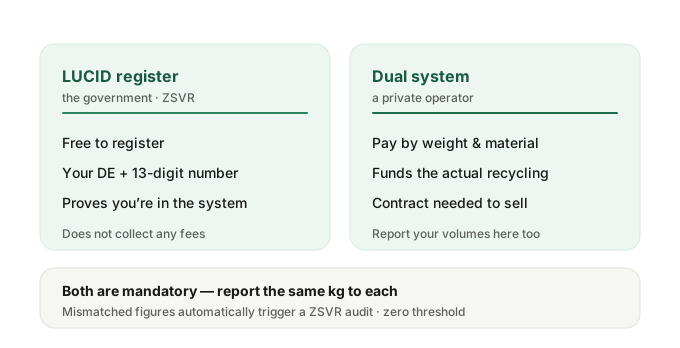
Then comes the reporting discipline. The core rule is dual reporting: every volume figure you declare must be submitted identically to your dual system and to the LUCID portal. If your dual system shows 500 kg of paper licensed while LUCID shows 400 kg or nothing, the ZSVR flags the mismatch for audit automatically.
Depending on contract size, your dual system may want actual shipped weights monthly, quarterly or annually, but every seller must file a year-end volume report (Jahresabschlussmeldung) early in the new year, reconciling final weights with the dual system and mirroring them into LUCID. Data must be broken down by material fraction - paper and cardboard, plastics, glass, ferrous metals, aluminium and beverage cartons - never as a single "boxes" line.
High-volume sellers face an extra audit step, the Declaration of Completeness (Vollständigkeitserklärung). It is triggered when annual German packaging volumes exceed any of these bands:
| Material category | Threshold |
|---|---|
| Glass packaging | 80,000 kg |
| Paper, paperboard and cardboard | 50,000 kg |
| Plastics, aluminium, ferrous metals and composites combined | 30,000 kg |
Above these lines you cannot simply key figures in. Your data must be audited and digitally signed by a registered auditor or certified tax advisor and filed in LUCID by 15 May. Most small and medium e-commerce sellers stay below the bands and file only the standard year-end report.
Registering, tracking and reporting these fractions by hand is slow work. Gramta turns your real e-commerce orders into the packaging reports each scheme asks for in Germany and beyond. See Gramta in action.
stiftung EAR and DIVID: the registers beyond packaging
Packaging is the register almost every seller needs, but it is rarely the only one. A webshop shipping packaged electronics with batteries inside can touch three separate German registers in a single parcel, each with its own authority, cost model and rules.
Electronics and batteries both sit with the federal WEEE and batteries register, stiftung EAR. It charges administrative fees per brand and per equipment or battery type, and - unlike LUCID - it makes a German authorised representative mandatory for foreign producers.
The German battery rules were rebuilt under the new Battery Act (BattDG), and the transition had a hard edge worth knowing: registrations under the old regime lapsed on 15 January 2026 unless the producer proved scheme participation under the BattDG. A lapse was treated as a retroactive revocation back to 1 January 2026, meaning an immediate sales ban that reached even fulfilment warehouses.
Single-use plastics run through the Single-Use Plastics Fund levy platform, DIVID, which charges a per-kilogram levy by product type. DIVID is also where a fresh duty lands: fireworks became fee-liable products from the start of 2026, with producers required to register by 31 December 2026 and the levy applying from January 2027. Vehicles carry an active duty too, but as a physical free take-back network rather than a register listing.
The Pfand deposit registers nothing: LUCID still applies
Germany's deposit-return system, the Pfand, is easy to confuse with EPR but is a separate scheme. It has applied to single-use drinks bottles and cans since 2003 and was extended to milk and milk-mix drinks in single-use plastic bottles on 1 January 2024. Paying a deposit registers nothing. The two systems meet on the same bottle: deposit-bearing packaging is exempt from dual-system fees, yet the LUCID registration duty still applies to it. Treat the Pfand as a consumer return loop, not a substitute for your packaging registration.
Compliance milestones for German packaging sellers
Germany's calendar is unusually concrete, and a national reform arrives alongside the EU-wide one. The milestones below are current as of this review; for how the same reform lands across the bloc, see our overview of EPR by country in Europe.
| Date | What happens |
|---|---|
| 1 Jan 2019 | The VerpackG takes effect; LUCID registration becomes mandatory for packaging producers. |
| 1 Jul 2022 | Marketplaces must block unregistered producers from selling packaged goods. |
| 1 Jul 2023 | The same marketplace gatekeeping extends to electronics. |
| 1 Jan 2024 | The Pfand deposit is extended to milk and milk-mix drinks in single-use plastic bottles. |
| 15 Jan 2026 | Old battery registrations lapse unless BattDG scheme participation is proven, with a retroactive sales ban back to 1 January. |
| 12 Aug 2026 | The VerpackDG replaces the VerpackG as the PPWR becomes applicable EU-wide. |
| 31 Dec 2026 | Fireworks producers must be registered in DIVID; the levy applies from January 2027. |
| 17 Apr 2028 | Textile EPR schemes are required under the revised EU Waste Framework Directive; German implementing law is still pending. |
The headline change has landed. The VerpackDG, which cleared the Bundestag on 11 June 2026 and was published in the Bundesgesetzblatt on 17 July 2026, entered into force on 12 August 2026, the day the PPWR became directly applicable, and the VerpackG expired at the end of 11 August 2026. It does not scrap LUCID or the dual systems - you keep your registration and your contracts - but it aligns German rules with the new EU recyclability grades, so dual-system fees become eco-modulated: mono-materials that are easy to recycle cost less, hard-to-recycle composites cost more. That eco-modulation follows the PPWR's own timetable rather than starting now: the design-for-recycling grades in Article 6 and the fee modulation keyed to them arrive with delegated acts due by 1 January 2028 and apply from 1 January 2030 at the earliest.
Stop losing days to dual-reporting spreadsheets. Gramta maps your orders to the exact material fractions LUCID and your German dual system require. Get started with Gramta.
Sources:
Frequently asked questions
- Is there a minimum threshold for packaging EPR in Germany?
- No. Germany applies no de minimis exemption for packaging. The obligation begins with the first gram you place on the market, so you must be registered in LUCID and hold a dual-system contract before your first shipment to a German household.
- What is a LUCID number and who issues it?
- A LUCID number is the registration code issued by the German Central Agency Packaging Register (ZSVR) when you register in its LUCID portal. Registration is free, and you need the number before selling packaged goods to German consumers.
- What are the fines for breaching the VerpackG in Germany?
- Administrative fines run up to EUR 100,000 for a registration failure and up to EUR 200,000 for selling without dual-system participation. The ZSVR has referred more than 20,000 suspected cases to enforcement authorities since 2019.
- Do foreign sellers need a German authorised representative?
- It depends on the register. LUCID registration for packaging is a personal duty you cannot delegate, so you register yourself. For electronics and batteries, stiftung EAR requires foreign producers to appoint a German authorised representative.
- Is the Pfand deposit the same as packaging EPR?
- No. The Pfand is a separate deposit-return system for single-use drinks containers. Deposit-bearing packaging is exempt from dual-system fees, but the LUCID registration duty still applies to it.
- When did the VerpackDG replace the VerpackG?
- On 12 August 2026, the day the EU Packaging and Packaging Waste Regulation (PPWR) became applicable. The VerpackDG was published in the Bundesgesetzblatt on 17 July 2026 and entered into force on 12 August 2026; the VerpackG expired at the end of 11 August 2026. LUCID and dual-system duties continue under the new law, so your registration and your dual-system contract carry over.
Reviewed by Anton Kröger